
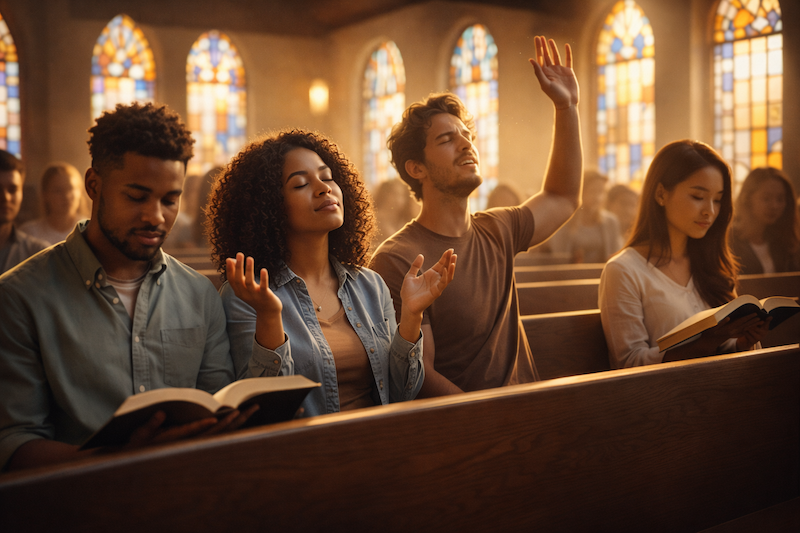

They called them the “least religious generation.”
For years, researchers warned that Gen Z — those born between 1997 and 2012 — represented the final nail in Christianity’s coffin. Church attendance was plummeting. Religious affiliation was cratering. The “Nones” (those claiming no religious affiliation) were growing faster than any other group.
Then something unexpected happened.
Bible sales hit record highs. Church attendance started climbing. And the generation everyone wrote off began showing up — not just for Christmas and Easter, but week after week.
Welcome to the Quiet Revival.
The Numbers Don’t Lie
The data coming out of 2025 and early 2026 has stunned researchers, publishers, and church leaders alike.
In the United Kingdom, Bible sales reached their highest point ever in 2025 — a staggering 134% increase in value over six years. According to Nielsen BookScan data, revenue from Bible sales hit £6.3 million, up from just £2.7 million in 2019. Moreover, the number of physical copies sold rose by 27.7% in a single year — the largest annual increase ever recorded.
The trend is equally dramatic in the United States. Industry analyst Brenna Connor reported that 2025 marked a 21-year high for Bible sales in America, with approximately 19 million copies sold. That’s twice the number sold in 2019 and a 12% increase from 2024.
“The greater interest in religious content in the U.S. reflects a bigger search for hope and community,” Connor explained. “Consumers are increasingly turning to faith-based resources as anchors of stability and sources of comfort during uncertain times.”
Gen Z Is Leading the Charge
Perhaps the most surprising element of this revival is who’s driving it.
According to <a href=”https://www.barna.com/trends/bible-reading-trends/” target=”_blank” rel=”noopener”>Barna Group research</a>, weekly Bible reading among U.S. adults jumped 12 percentage points — from 30% in 2024 to 42% in 2025. Among self-identified Christians, that number reaches 50% — the highest level in over a decade.
“2025 is showing a major rebound of Bible reading, along with a surge in usage among younger generations,” said David Kinnaman, CEO of Barna Group. “This aligns with other signs of spiritual interest and reinforces the finding that Christian faith and practice are experiencing a reset moment.”
Furthermore, the <a href=”https://www.biblesociety.org.uk/” target=”_blank” rel=”noopener”>Bible Society</a> reports that UK church attendance among 18- to 24-year-olds has jumped from just 4% in 2018 to 16% today. That’s a fourfold increase in just seven years.
Even more striking: only 13% of Gen Z identify as atheist, compared to 25% of Gen X. The generation raised on social media and smartphones is, paradoxically, the one turning back to ancient texts and traditional worship.
Young Men Are Leading the Way
Here’s where the story takes an even more unexpected turn.
For decades, women have consistently outpaced men in religious participation. Church pews filled with grandmothers. Bible studies attracted mostly female attendees. Men, particularly young men, seemed allergic to organized religion.
That pattern has now reversed.
Barna’s 2025 data reveals that younger men are outpacing younger women in Scripture engagement. Additionally, men reported higher church attendance than women in 2025 — reversing a 25-year trend.
“These findings are unexpected,” Kinnaman observed. “Women generally have been more religiously active than men. But now, younger men emerge as the most frequent Bible readers.”
Daniel Copeland, Barna’s vice president of research, confirmed the trend: “Gen Z men are attending slightly more often than Millennial men, marking a generational reversal. This data represents good news for church leaders and adds to the picture that spiritual renewal is shaping Gen Z and Millennials today.”
Why Is This Happening?
Researchers and commentators have proposed several theories to explain this surprising shift.
The Emptiness of “Having Everything”
Gen Z grew up with unprecedented access to information, entertainment, and social connection. They can access any song, any movie, any piece of knowledge instantly. They can curate their appearance with filters and tutorials. They can measure their worth in likes and followers.
And yet, it’s not enough.
“Getting everything you want only serves to show you that you wanted the wrong things,” wrote Lauren Windle, publishing director at SPCK Group. “It’s awful to fight for more followers, or a better body, or a higher salary, only to realise that the same insecurities and anxieties plague the slightly more ‘successful’ version of you too.”
Consequently, many young people are discovering that the promises of secular culture ring hollow. The endless scroll leaves them empty. The pursuit of optimization exhausts them. And they’re looking for something deeper.
The Collapse of New Atheism
In the early 2000s, the “New Atheism” movement — championed by figures like Richard Dawkins and Christopher Hitchens — gained significant traction. Religion was dismissed as a dangerous delusion, something educated people would inevitably outgrow.
By 2025, however, this movement has largely exhausted itself. As one researcher noted, it has been “replaced by nuanced curiosity and, in some cases, a robust defense of religion among the epistemic elite.”
Public intellectuals like Jordan Peterson have played a crucial role in “re-enchanting” the Bible for a secular male audience. By framing biblical narratives as psychological maps for meaning rather than merely metaphysical claims, they’ve created an on-ramp for skeptical young men to engage with religious texts.
The Rise of Digital Orthodoxy
Interestingly, the internet — often blamed for secularization — may actually be fueling the revival.
Online communities have emerged around traditional Christianity, where the aesthetic of antiquity and rigorous discipline appeals to young people disillusioned by the spiritual vacuity of modern life. Orthodox Christianity, Catholicism, and traditional Protestantism have found new audiences through podcasts, YouTube channels, and social media.
The data supports this. Over the Christmas period in the UK, 45% of adults said they planned to attend a church event or service — up from 40% the previous year.
God Is Simply Calling
Some observers suggest a simpler explanation: God is at work.
“What if none of this has anything to do with our work?” Windle asked. “Sure, we can look at the social factors, how perceptions of the church have changed and what they offer now, but what if God’s just calling and people are listening?”
Churches report stories of people dreaming about attending services and showing up the next day. Others describe walking past church buildings, hearing music, and feeling compelled to enter.
Perhaps the best response is simply to be ready with open arms.
A Global Phenomenon
The revival isn’t limited to the English-speaking world.
In France, baptisms increased by 45% in 2025 — a remarkable surge in one of Europe’s most secular nations. Meanwhile, the Bible Society estimates that more than 2 million additional people now attend church in the UK compared to a decade ago, with growth concentrated among Catholics and Pentecostals.
Even in highly secularized Western Europe, where over 50% of those under 40 don’t identify with any faith, green shoots of spiritual renewal are appearing.
Signs in Popular Culture
The revival has spilled into mainstream culture as well.
In 2025, two Christian songs — Brandon Lake’s “Hard Fought Hallelujah” and Forrest Frank’s “Your Way’s Better” — appeared simultaneously on the Billboard Hot 100. This hadn’t happened in more than a decade.
Additionally, season 23 of “American Idol” featured a three-hour Easter Sunday special highlighting songs of faith. And Angel Studios’ animated film “David” opened to $22 million — the highest-grossing opening for a faith-based animated film in movie history.
The culture is shifting, and entertainment is following.
What This Means for Churches
For church leaders, the data presents both an opportunity and a challenge.
The opportunity is clear: young people are searching for meaning, community, and truth. They’re picking up Bibles and walking through church doors. Many arrive with no prior Christian background, motivated by a genuine desire to understand both the world around them and their own inner lives.
The challenge, however, is equally real. These seekers are not looking for watered-down spirituality or entertainment-driven services. Research suggests they’re drawn to churches that offer substance — theological depth, authentic community, and clear moral guidance.
Steve Barnet, owner of St Andrews Bookshop in Buckinghamshire, described the change as “unexpected and striking.” He noted a growing number of young men visiting his shop in search of religious texts. “It feels as though something fundamental has shifted in how people relate to faith,” he said.
HarperCollins Christian Publishing CEO Mark Schoenwald confirmed that readers are going deeper: “We just surpassed 10 million units of the NIV Study Bible. What that tells me is people are not just buying Bibles, but they’re actually trying to read them and understand them and then apply them to their lives.”
The Road Ahead
Not everyone is convinced the revival will last. Some researchers caution that the data may reflect temporary trends rather than permanent shifts. The decline of religion remains a fundamental reality in much of the Western world, and an estimated 100,000 churches may close in the coming years.
Nevertheless, the current moment represents something significant. For the first time in decades, the trajectory of religious engagement among young adults has reversed. Gen Z — the generation everyone assumed would finish off Christianity — may instead be the one that revives it.
As one analyst put it: “We are witnessing a complex spiritual restructuring that intersects with economic mobility, demographic resilience, and a profound intellectual realignment.”
Or, to put it more simply: God is moving, and young people are responding.
Frequently Asked Questions
Is Gen Z really returning to church?
Yes. According to Bible Society research, UK church attendance among 18- to 24-year-olds has increased from 4% in 2018 to 16% today — a fourfold increase. Barna Group data shows similar trends in the United States, with Gen Z and Millennials driving increased church attendance and Bible reading.
Why are Bible sales increasing?
Bible sales reached record highs in both the UK and US in 2025. Analysts attribute the surge to Gen Z’s search for meaning, community, and stability during uncertain times. UK Bible sales increased 134% since 2019, while US sales hit a 21-year high with 19 million copies sold.
Are young men really attending church more than women?
Yes. Barna Group’s 2025 data shows that younger men now outpace younger women in Bible reading and church attendance — reversing a 25-year trend where women were consistently more religiously active than men.
What is the “Quiet Revival”?
The “Quiet Revival” is a term coined by the Bible Society to describe the unexpected increase in church attendance and religious engagement among young adults, particularly Gen Z. Unlike dramatic historical revivals, this movement has grown gradually through individual conversions and renewed interest in faith.
Why is Gen Z interested in Christianity?
Researchers suggest several factors: disillusionment with social media and secular culture, the collapse of New Atheism as an intellectual movement, the influence of public intellectuals like Jordan Peterson, the appeal of traditional religious communities, and — some would say — God simply calling a new generation to faith.
Is this revival happening outside the US and UK?
Yes. France saw a 45% increase in baptisms in 2025. Similar trends are appearing across Western Europe and in other parts of the world, though the revival is most pronounced in English-speaking countries.
What percentage of Gen Z identifies as atheist?
Only 13% of Gen Z identify as atheist, compared to 25% of Gen X. This makes Gen Z surprisingly less atheistic than the generation that preceded them.
Which churches are growing the fastest?
Growth is concentrated among Catholics, Pentecostals, and churches offering traditional worship with theological substance. Research suggests young seekers are drawn to authenticity and depth rather than entertainment-driven services.
How can churches reach Gen Z?
Churches can reach Gen Z by offering theological depth, authentic community, clear moral teaching, and opportunities for genuine spiritual growth. Many young seekers arrive with no Christian background and appreciate churches willing to explain the basics without condescension.
Will the revival last?
While some researchers remain cautious, the data suggests a genuine shift in how young people relate to faith. Whether this represents a temporary trend or a lasting transformation remains to be seen, but the current trajectory is undeniably positive for Christian engagement.
Closing Verse:
“I will pour out my Spirit on all flesh; your sons and your daughters shall prophesy, your old men shall dream dreams, and your young men shall see visions.” — Joel 2:28 (ESV)