

Who Was Thomas?
Thomas — also called Didymus, meaning “the Twin” — was one of Jesus’ twelve apostles. Despite being a faithful follower throughout Christ’s ministry, he’s remembered primarily for one moment of doubt. That single incident earned him a nickname that has stuck for two thousand years: “Doubting Thomas.”
But is that label fair? And what can we learn from this honest, questioning disciple?
As it turns out, Thomas’s story offers profound encouragement for anyone who has ever wrestled with faith. His journey from doubt to declaration — “My Lord and my God!” — remains one of the most powerful encounters with the risen Christ recorded in Scripture.
Thomas Before the Doubt
Before examining his famous moment of scepticism, we should recognise that Thomas demonstrated remarkable faith and courage earlier in the Gospels.
Willing to Die with Jesus
When Jesus announced He was returning to Judea — where religious leaders had recently tried to stone Him — the disciples were understandably afraid. Thomas, however, responded with bold loyalty:
John 11:16 — “Then Thomas (also known as Didymus) said to the rest of the disciples, ‘Let us also go, that we may die with him.'”
This wasn’t the statement of a coward or a chronic doubter. On the contrary, Thomas was prepared to face death alongside his Master. His commitment ran deep, even when danger loomed.
Honest About What He Didn’t Understand
Later, during the Last Supper, Jesus told the disciples He was going to prepare a place for them and that they knew the way. Thomas wasn’t content to nod along in confusion. Instead, he asked the question everyone else was probably thinking:
John 14:5 — “Thomas said to him, ‘Lord, we don’t know where you are going, so how can we know the way?'”
This honest question prompted one of Jesus’ most famous declarations: “I am the way and the truth and the life” (John 14:6). Thomas’s willingness to admit uncertainty led to a clearer revelation for everyone present.
The Moment of Doubt
After Jesus’ crucifixion, the disciples gathered behind locked doors, terrified that the authorities might come for them next. On Easter evening, Jesus suddenly appeared among them.
John 20:19-20 — “On the evening of that first day of the week, when the disciples were together, with the doors locked for fear of the Jewish leaders, Jesus came and stood among them and said, ‘Peace be with you!’ After he said this, he showed them his hands and side. The disciples were overjoyed when they saw the Lord.”
But Thomas wasn’t there. We don’t know where he was or why he had separated from the group. Perhaps grief drove him to solitude. Perhaps he needed space to process his shattered hopes. Whatever the reason, he missed this pivotal encounter.
Thomas Refuses to Believe Secondhand Reports
When the other disciples found Thomas and excitedly told him what happened, he refused to accept their testimony:
John 20:25 — “So the other disciples told him, ‘We have seen the Lord!’ But he said to them, ‘Unless I see the nail marks in his hands and put my finger where the nails were, and put my hand into his side, I will not believe.'”
Thomas demanded physical, tangible evidence. He wanted to touch the wounds himself. Hearsay wasn’t enough — even from his closest friends.
Was this unreasonable? Consider that the other disciples didn’t believe based on the women’s testimony either. Mary Magdalene had announced, “I have seen the Lord!” (John 20:18), yet the men remained hiding behind locked doors. They only believed after seeing Jesus themselves.
Thomas simply wanted what the others had already received: a personal encounter with the risen Christ.
Jesus Meets Thomas in His Doubt
A week passed. The disciples gathered again, and this time Thomas was present. Once more, Jesus appeared despite the locked doors:
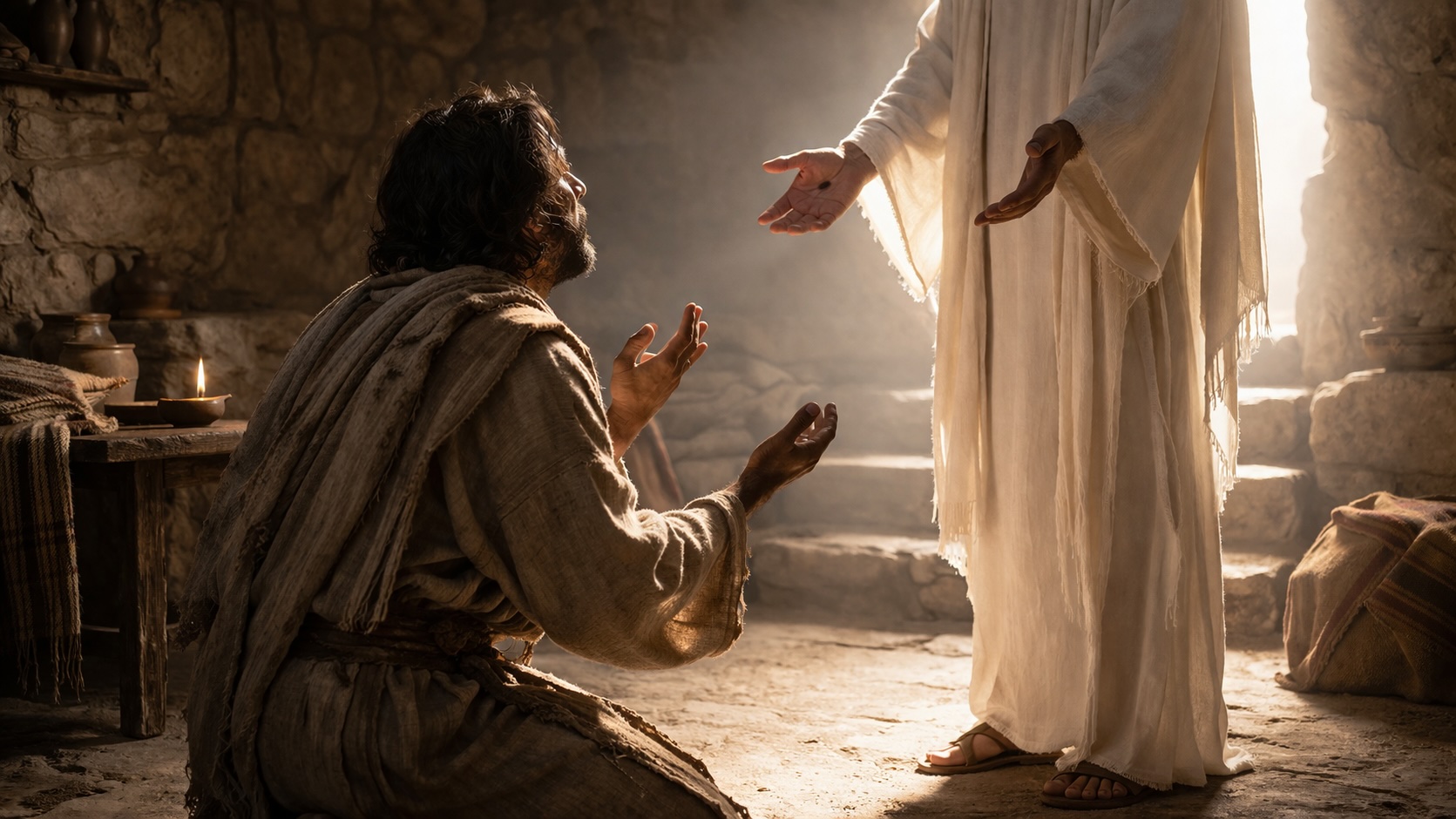
John 20:26-27 — “A week later his disciples were in the house again, and Thomas was with them. Though the doors were locked, Jesus came and stood among them and said, ‘Peace be with you!’ Then he said to Thomas, ‘Put your finger here; see my hands. Reach out your hand and put it into my side. Stop doubting and believe.'”
Notice several remarkable details about this encounter.
First, Jesus came specifically for Thomas. He addressed Thomas directly and immediately. The Good Shepherd pursues the one struggling sheep.
Second, Jesus met Thomas exactly where he was. Thomas had demanded to see and touch the wounds. Jesus invited him to do precisely that. He didn’t rebuke Thomas for having conditions — He fulfilled them.
Third, Jesus knew what Thomas had said even though He wasn’t physically present when Thomas spoke those words. This subtle detail demonstrates Christ’s divine omniscience and His intimate knowledge of each disciple’s heart.
Thomas’s Declaration of Faith
How did Thomas respond to this gracious confrontation? With one of the most powerful confessions of faith in all of Scripture:
John 20:28 — “Thomas said to him, ‘My Lord and my God!'”
In a single breath, Thomas declared Jesus to be both Lord (Kyrios) and God (Theos). This wasn’t merely an expression of surprise or relief. It was a profound theological statement — an explicit affirmation of Christ’s deity.
Interestingly, we’re not told whether Thomas actually touched Jesus’ wounds. The text moves straight from Jesus’ invitation to Thomas’s confession. Perhaps seeing was enough. Perhaps the offer itself dissolved his doubt. Either way, Thomas moved from demanding proof to worshipping his risen Lord.
Jesus accepted this worship without correction. If Jesus were merely human, such worship would be blasphemous. By receiving it, He affirmed Thomas’s confession as true.
Jesus’ Words About Believing Without Seeing
Following Thomas’s declaration, Jesus offered a gentle challenge — and a blessing:
John 20:29 — “Then Jesus told him, ‘Because you have seen me, you have believed; blessed are those who have not seen and yet have believed.'”
Jesus didn’t condemn Thomas for needing to see. However, He pronounced a special blessing on those who would believe without physical sight.
This blessing extends across centuries to every believer since. We haven’t seen the risen Christ with our eyes or touched His wounds with our hands. Yet we believe. And Jesus calls us blessed.
1 Peter 1:8-9 — “Though you have not seen him, you love him; and even though you do not see him now, you believe in him and are filled with an inexpressible and glorious joy, for you are receiving the end result of your faith, the salvation of your souls.”
Faith that trusts without demanding visible proof honours God deeply. It’s not blind faith — it’s faith grounded in reliable testimony, historical evidence, and the inner witness of the Holy Spirit.
What Thomas Teaches Us About Doubt
Thomas’s story offers rich lessons for anyone struggling with doubt today.
1. Doubt Doesn’t Disqualify You
Thomas doubted the resurrection for an entire week. Yet Jesus didn’t reject him, replace him, or remove him from the Twelve. Instead, He pursued Thomas with patience and grace.
If you’re wrestling with questions about your faith, know this: doubt doesn’t place you beyond God’s reach. He meets honest doubters with compassion, not condemnation.
2. Honest Questions Are Welcome
Thomas didn’t pretend to believe when he didn’t. He voiced his struggle openly. And that honesty created space for a transformative encounter with Christ.
Superficial faith that suppresses questions is weaker than honest faith that wrestles through them. God isn’t threatened by your questions. In fact, He often uses them to deepen your understanding and strengthen your trust.
3. Jesus Provides What We Need
Thomas needed evidence. Jesus provided it. He met Thomas at his point of struggle and gave him exactly what he required to believe.
God knows what you need. He may not answer every question immediately, but He provides sufficient reason to trust Him. Through Scripture, through the testimony of others, through the Spirit’s work in your heart — He gives evidence to those who sincerely seek.
4. Doubt Can Lead to Deeper Faith
Thomas’s doubt didn’t lead to apostasy. Instead, it led to one of the strongest declarations of faith recorded in the Gospels. His confession — “My Lord and my God!” — surpassed what any other disciple had explicitly stated.
Seasons of doubt, when navigated honestly before God, often produce firmer faith on the other side. Wrestling strengthens muscles. Questioning clarifies conviction.
5. Community Matters in Seasons of Doubt
Thomas isolated himself on Easter evening, and he missed encountering Christ. When he rejoined the community a week later, Jesus appeared.
If you’re struggling with doubt, don’t withdraw from other believers. Stay connected to the church. Keep gathering with those who can encourage you, pray for you, and remind you of truth. Faith flourishes in community.
The Rest of Thomas’s Story
Thomas’s doubt didn’t define his destiny. According to early church tradition, he became one of the boldest apostles — carrying the gospel farther east than any other.
Ancient sources indicate that Thomas travelled to Parthia (modern Iran), and eventually to India, where he established churches that still exist today. The Mar Thoma Christians of India trace their heritage directly to the apostle Thomas.
Tradition holds that Thomas was martyred near Chennai, India — killed with a spear while praying. The doubter became a martyr. The one who demanded proof gave his life for what he came to believe.
Thomas’s journey from “Unless I see… I will not believe” to dying for Christ demonstrates that doubt, when brought honestly to Jesus, can transform into unshakeable conviction.
How to Navigate Your Own Doubts
If you identify with Thomas — if questions nag at your faith or certainty feels elusive — here are some practical steps:
Bring Your Doubts to Jesus
Don’t hide your struggles from God. He already knows them. Pour out your questions in prayer. Ask Him to meet you where you are. Thomas received a personal encounter because he was honest about what he needed.
Stay in Community
Resist the urge to isolate. Keep attending church. Maintain relationships with mature believers. Allow others to strengthen your faith when yours feels weak.
Examine the Evidence
Christianity invites investigation. Study the historical evidence for the resurrection. Read the Gospel accounts carefully. Explore the testimonies of transformed lives throughout history. Faith isn’t opposed to evidence — it’s built upon it.
Give It Time
Thomas doubted for a week before Jesus appeared. Sometimes we must wait for clarity. Don’t demand instant resolution. Trust that God is working even when you can’t see it.
Remember What You Know
In seasons of doubt, we often forget what we once knew clearly. Journal about past experiences of God’s faithfulness. Revisit answered prayers. Remind yourself of the truths that once seemed certain. Feelings fluctuate, but truth remains.
A Prayer for Those Who Doubt
Lord Jesus, You met Thomas in his doubt with patience, grace, and overwhelming evidence. Meet us too.
Some of us wrestle with questions we’re afraid to voice. Some of us struggle to believe what we once held dear. Some of us feel distant from You even as we long to draw near.
Do for us what You did for Thomas. Draw close. Reveal Yourself. Provide what we need to trust You more deeply.
Help us to be honest about our struggles and brave enough to stay in community when we’d rather hide. Remind us that doubt doesn’t disqualify us — and that wrestling with You can lead to deeper faith.
Like Thomas, may we move from uncertainty to confident declaration: “My Lord and my God!”
In Your patient and pursuing name, Amen.