
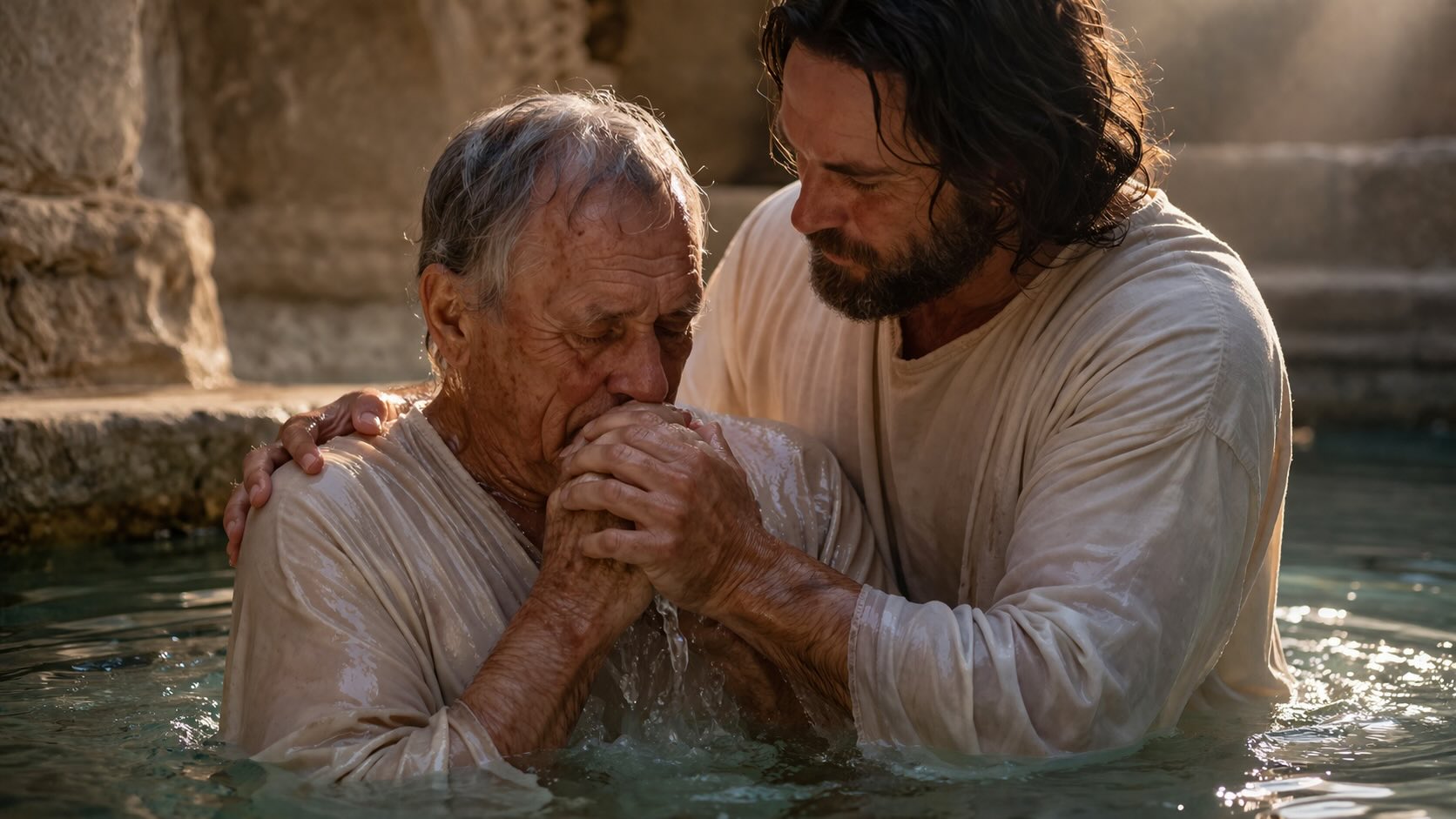

When you’re young, bath time is chaos — splashing, laughing, soap in your eyes, your dad pretending the rubber duck can talk. Years later, you might find yourself helping that same man into the tub. No one’s laughing now.
An old Turkish proverb puts it this way:
“If a father bathes his children, both will laugh. If a son bathes his father, both will cry.”
This simple saying is sweeping across social media, shared by millions who recognise something painfully true in its words. In two sentences, it captures the entire arc of human life — from joyful dependence to sorrowful role reversal.
For Christians, this proverb speaks to something even deeper: the sacred calling to honour our parents, the weight of caregiving, and the hope we have beyond the grave.
The Original Turkish Proverb
The English version circulating online reads: “If a father bathes his children, both will laugh, and if a son bathes his father, both will cry.”
In Turkish, one common rendering is:
“Bir baba çocuklarını yıkarsa ikisi de güler; bir oğul babasını yıkarsa ikisi de ağlar.”
Here’s what the words mean:
- Baba — father
- Çocuklarını — his children
- Yıkarsa — if he washes/bathes
- Güler — laughs
- Oğul — son
- Babasını — his father
- Ağlar — cries
Like many proverbs passed down through generations, there’s no single “official” version. Different translations exist across Turkish-speaking communities. However, the meaning remains consistent regardless of the exact wording.
The proverb doesn’t belong to one culture alone. Similar sayings exist across the Middle East, South Asia, and beyond — because the truth it expresses is universal.
What the Proverb Actually Means
On the surface, this proverb contrasts two bathing scenes. But it’s not really about bathing at all.
The first scene is joy. A young father washes his small children. They squirm and giggle. Water splashes everywhere. The father smiles because this is what life is supposed to look like — strength serving weakness, the capable nurturing the helpless. Both laugh because the moment feels right, natural, full of life.
The second scene is sorrow. Years have passed. The child is now a grown man. His father has become frail, unable to care for himself. Now the son must do what his father once did for him — wash, clean, tend to basic needs. Both cry.
But why do both cry?
The father cries because he remembers when he was strong. He recalls bathing this very son decades ago. Now he’s the helpless one, stripped of independence and dignity. Mortality stares back at him from the bathwater.
The son cries because he sees his father’s frailty — and glimpses his own future. He grieves the man his father used to be. He feels the weight of time passing, of roles reversing, of the unavoidable truth that life moves in one direction.
The tears aren’t just sadness. They’re also gratitude, love, and deep emotional connection. Father and son weep together because their bond runs so deep that words fail. Only tears will do.
This is the full circle of life: the one who once carried you will one day need to be carried.
Why This Proverb Matters Today
This ancient saying has gone viral for a reason. It strikes a nerve in our modern world.
We’re Busier Than Ever
Many people today are consumed by work, screens, and endless distractions. In the rush to build careers and chase success, family often falls to the bottom of the priority list. Weeks pass without a phone call. Months pass without a visit. Then suddenly, a parent falls ill — and we realise how much time we’ve wasted.
The proverb cuts through our excuses. It reminds us that the window for caring won’t stay open forever.
Elder Care Is a Growing Crisis
Across the world, populations are aging rapidly. More people than ever are facing the reality of caring for elderly parents — often while juggling jobs, children, and their own health challenges.
In some cultures, multi-generational households remain the norm. In others, aging parents are placed in care facilities and rarely visited. This proverb challenges us to examine where we stand. Are we honouring our parents, or have we outsourced our responsibility?
Convenience Has Replaced Commitment
Modern life celebrates independence and self-sufficiency. We’re taught to build our own lives, pursue our own dreams, and avoid being “burdened” by others.
But the proverb reminds us that relationships aren’t meant to be convenient. Love costs something. Caring for aging parents is inconvenient, exhausting, and often thankless. Yet it’s also one of the most human — and most holy — things we can do.
We Need to Relearn Patience and Empathy
Caring for someone who moves slowly, forgets things, or needs help with basic tasks requires deep patience. Our fast-paced culture hasn’t trained us for this.
The proverb teaches that one day, we too will be the slow ones. We’ll be the ones who need help. How we treat our parents now shapes how we’ll be treated later — and more importantly, it reveals the condition of our hearts.
What the Bible Says About Honouring Aging Parents
Scripture speaks directly to this responsibility. Honouring parents is so important that God included it in the Ten Commandments:
Exodus 20:12 — “Honour your father and your mother, so that you may live long in the land the LORD your God is giving you.”
This command has no expiration date. It doesn’t stop when we become adults, and it certainly doesn’t stop when our parents become dependent. If anything, it becomes more urgent.
The New Testament reinforces this obligation in even stronger terms:
1 Timothy 5:4 — “But if a widow has children or grandchildren, these should learn first of all to put their religion into practice by caring for their own family and so repaying their parents and grandparents, for this is pleasing to God.”
1 Timothy 5:8 — “Anyone who does not provide for their relatives, and especially for their own household, has denied the faith and is worse than an unbeliever.”
Paul didn’t mince words. Caring for aging parents isn’t optional for Christians — it’s a fundamental expression of genuine faith. You can attend church every Sunday and quote Scripture all day, but if you neglect your own parents, something is deeply wrong.
Jesus Honoured His Mother from the Cross
Even in His final moments, Jesus modelled what it means to honour a parent.
While hanging on the cross — enduring unimaginable agony, bearing the sins of humanity — Jesus looked down and saw His mother Mary standing nearby. Despite everything He was suffering, He thought of her future:
John 19:26-27 — “When Jesus saw his mother there, and the disciple whom he loved standing nearby, he said to her, ‘Woman, here is your son,’ and to the disciple, ‘Here is your mother.’ From that time on, this disciple took her into his home.”
With some of His last breaths, Jesus ensured Mary would be cared for. He entrusted her to John, making provision for her even while dying for the world.
If the Son of God prioritised His mother’s wellbeing in that moment, how much more should we prioritise our parents while we still have the opportunity?
The Grief and Glory of Caregiving
Caring for aging parents is holy work. But let’s be honest — it’s also hard work.
The Turkish proverb acknowledges what many caregivers feel but struggle to express: grief coexists with love. Watching a parent decline — physically, mentally, sometimes both — is deeply painful. The person who raised you becomes someone who needs you to raise them through their final years.
You may find yourself mourning even while they’re still alive. Psychologists call this anticipatory grief, and it’s completely normal. You grieve the father who once threw you on his shoulders. You grieve the mother who stayed up all night when you were sick. They’re still here, but they’re different now. And that hurts.
Yet there is glory in this calling. When you feed your father who can no longer lift a spoon, you’re serving Christ. When you bathe your mother who can no longer stand alone, you’re loving as Jesus loved.
Matthew 25:40 — “Truly I tell you, whatever you did for one of the least of these brothers and sisters of mine, you did for me.”
The tasks may feel menial, even humiliating. But heaven sees them as worship.
Learning from Ruth: Loyalty That Stays
The Bible gives us a powerful example of intergenerational faithfulness in the story of Ruth.
When Naomi lost her husband and both sons, she was left destitute in a foreign land. She told her daughters-in-law to return to their own families and start fresh. Orpah left — understandably. But Ruth refused:
Ruth 1:16-17 — “Don’t urge me to leave you or to turn back from you. Where you go I will go, and where you stay I will stay. Your people will be my people and your God my God. Where you die I will die, and there I will be buried.”
Ruth committed herself to caring for Naomi even though it cost her everything — her homeland, her prospects, her future security. She gleaned in fields to provide food. She protected Naomi’s dignity. She stayed when leaving would have been easier.
God honoured Ruth’s faithfulness beyond anything she could have imagined. She married Boaz, became the great-grandmother of King David, and entered the lineage of Jesus Christ Himself.
When we care for our aging parents with Ruth-like devotion, we participate in a legacy that extends far beyond what we can see.
Life Comes Full Circle
The proverb’s deepest truth is this: life comes full circle.
Strength turns to dependence. The hands that once held us steady will one day tremble. The voice that taught us to speak will one day struggle to find words. The parent who seemed invincible will become fragile, mortal, in need.
This isn’t morbid — it’s simply reality. Denying it doesn’t help. Accepting it prepares us to love well.
For Christians, however, the circle doesn’t end at the grave. Resurrection awaits. Bodies will be renewed. Tears will be dried forever. The cycle of decline and death will finally break.
Revelation 21:4 — “He will wipe every tear from their eyes. There will be no more death or mourning or crying or pain, for the old order of things has passed away.”
One day, no one will need to bathe anyone. Strength will return. Dependence will end. And the laughter will never stop.
Practical Ways to Honour Aging Parents
If this proverb stirred something in your heart, here are practical ways to respond:
Be present. Time is the most precious gift. Visit regularly. Call often. Don’t let busyness steal the days you have left together.
Listen to their stories. Older parents often repeat themselves. Instead of tuning out, lean in. Their stories carry wisdom, history, and a legacy worth preserving.
Preserve their dignity. Aging involves loss of independence, which can feel humiliating. Whenever possible, let them make choices. Speak to them as adults. Protect their dignity fiercely.
Share the load. Caregiving shouldn’t fall on one sibling alone. Communicate openly with brothers and sisters. Divide responsibilities fairly. If you’re an only child, seek help from church, community, or professional caregivers.
Pray with them and for them. Spiritual care matters as much as physical care. Read Scripture together. Pray at their bedside. Remind them of God’s promises. Point them toward the hope of resurrection.
When Both Cry: Finding God in the Tears
The proverb says both will cry. Father and son. Parent and child.
This isn’t weakness. It’s love too deep for words. Tears acknowledge what language cannot fully express: that time is passing, that bodies are failing, that we are mortal.
But for Christians, tears also water the soil of hope.
Psalm 56:8 — “You have kept count of my tossings; put my tears in your bottle. Are they not in your book?”
God sees every tear shed in the sacred work of caregiving. He doesn’t dismiss them. He collects them. They matter to Him.
And when both cry, God is near.
A Prayer for Those Caring for Aging Parents
Heavenly Father, You command us to honour our parents, and You promise to be near the brokenhearted.
Today I lift up everyone caring for an aging mother or father. Give them strength when exhaustion overwhelms. Grant them patience when frustration rises. Fill them with grace when grief takes hold.
Remind them that this sacred work matters — that every small act of service is seen and treasured by You. Comfort them in the sorrow of watching their parents decline. And fill them with hope that one day, all tears will be wiped away.
Thank You for the gift of parents. Thank You for the privilege of caring for those who once cared for us. Help us to love well, to the very end.
In Jesus’ name, Amen.