
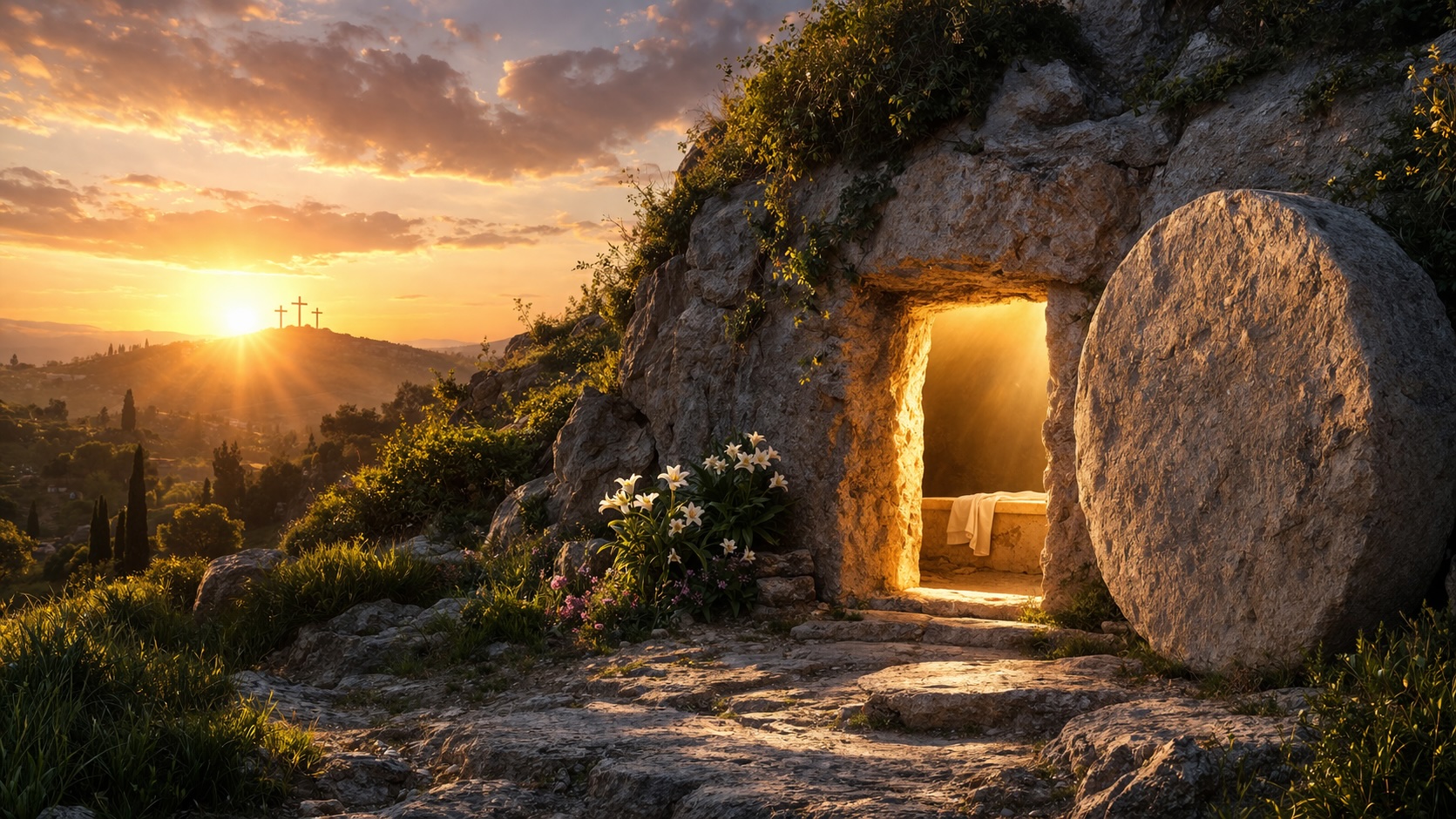

What Is Easter?
Easter is the most important day in the Christian calendar. On this day, Christians around the world celebrate the resurrection of Jesus Christ from the dead — the event that proves His victory over sin, death, and the grave.
In 2026, Easter Sunday falls on April 5th.
Without Easter, Christianity collapses. If Jesus stayed dead, then His claims were false, His sacrifice was meaningless, and our faith is worthless. However, because He rose, everything changes. Death no longer has the final word. Consequently, those who trust in Christ have the promise of eternal life.
1 Corinthians 15:17-20 — “And if Christ has not been raised, your faith is futile; you are still in your sins. Then those also who have fallen asleep in Christ are lost. If only for this life we have hope in Christ, we are of all people most to be pitied. But Christ has indeed been raised from the dead, the firstfruits of those who have fallen asleep.”
The Biblical Account: What Happened on Easter Morning?
All four Gospels record the resurrection (Matthew 28, Mark 16, Luke 24, John 20). Together, they paint a vivid picture of that first Easter morning.
The Women Arrive at the Tomb
At dawn on the first day of the week, several women went to the tomb to anoint Jesus’ body with spices. Mary Magdalene, Mary the mother of James, Salome, and possibly others made the journey while it was still dark.
As they walked, one question troubled them: “Who will roll the stone away from the entrance of the tomb?” (Mark 16:3). The massive stone seemed an impossible obstacle.
Mark 16:4 — “But when they looked up, they saw that the stone, which was very large, had been rolled away.”
The Tomb Was Empty
When the women arrived, they discovered something astonishing. Not only had the stone been moved, but the tomb was empty. Jesus’ body was gone.
An angel — or two angels, according to Luke and John — appeared to them with a message that would change the world:
Matthew 28:5-6 — “The angel said to the women, ‘Do not be afraid, for I know that you are looking for Jesus, who was crucified. He is not here; he has risen, just as he said. Come and see the place where he lay.'”
The grave clothes lay folded. Furthermore, the body was nowhere to be found. Jesus had risen from the dead.
Peter and John Run to the Tomb
Mary Magdalene ran to tell Peter and John. Immediately, both disciples sprinted to the tomb. John arrived first and saw the linen wrappings lying there. Then Peter arrived and went inside. When John followed him in, he “saw and believed” (John 20:8).
The evidence was undeniable. Something miraculous had happened.
Jesus Appears to Mary Magdalene
Mary Magdalene lingered at the tomb, weeping. As she turned around, she saw a man she assumed was the gardener. Then He spoke her name: “Mary.”
Instantly, she recognised Him. It was Jesus — alive, risen, standing before her.
John 20:16-17 — “‘Rabboni!’ (which means ‘Teacher’). Jesus said, ‘Do not hold on to me, for I have not yet ascended to the Father. Go instead to my brothers and tell them, “I am ascending to my Father and your Father, to my God and your God.”‘”
Mary became the first witness to the resurrection. She ran to tell the disciples: “I have seen the Lord!” (John 20:18).
Jesus Appears to the Disciples
That same evening, the disciples gathered behind locked doors, terrified of the Jewish authorities. Suddenly, Jesus appeared among them.
John 20:19-20 — “Jesus came and stood among them and said, ‘Peace be with you!’ After he said this, he showed them his hands and side. The disciples were overjoyed when they saw the Lord.”
Over the next forty days, Jesus appeared to many people — to the Eleven, to two disciples on the road to Emmaus, to Thomas who had doubted, and to more than five hundred believers at once (1 Corinthians 15:6). These were not hallucinations. On the contrary, they were physical, tangible encounters with the risen Christ.
Why Did Jesus Have to Rise?
The resurrection wasn’t optional — it was essential. Here’s why Easter changes everything:
1. The Resurrection Proves Jesus Is Who He Claimed to Be
Jesus made extraordinary claims. He said He was the Son of God, the Messiah, the way, the truth, and the life. Anyone can make such claims. However, rising from the dead validates them.
Romans 1:4 — “And who through the Spirit of holiness was appointed the Son of God in power by his resurrection from the dead: Jesus Christ our Lord.”
If Jesus stayed dead, He was either a liar or a lunatic. Because He rose, He is Lord.
2. The Resurrection Confirms Our Sins Are Forgiven
On the cross, Jesus paid the penalty for sin. But how do we know the payment was accepted? The resurrection is God’s receipt — His declaration that the debt has been paid in full.
Romans 4:25 — “He was delivered over to death for our sins and was raised to life for our justification.”
Because Jesus rose, we can be certain our sins are forgiven. His sacrifice was sufficient.
3. The Resurrection Defeats Death
Before Easter, death was humanity’s ultimate enemy. No one escaped it. Nevertheless, Jesus broke its power by walking out of the grave.
1 Corinthians 15:54-55 — “‘Death has been swallowed up in victory.’ ‘Where, O death, is your victory? Where, O death, is your sting?'”
Death is no longer the end for those who trust in Christ. Instead, it is a doorway to eternal life.
4. The Resurrection Guarantees Our Future Resurrection
Jesus didn’t just rise for Himself — He rose as the “firstfruits” of all who will rise. In other words, His resurrection is the prototype for ours.
1 Corinthians 15:20-22 — “But Christ has indeed been raised from the dead, the firstfruits of those who have fallen asleep. For since death came through a man, the resurrection of the dead comes also through a man. For as in Adam all die, so in Christ all will be made alive.”
Because He lives, we will live also (John 14:19). This is not wishful thinking — it is a guarantee.
5. The Resurrection Gives Us Power for Today
The same power that raised Jesus from the dead is available to believers right now. Therefore, we don’t have to live defeated lives.
Ephesians 1:19-20 — “His incomparably great power for us who believe. That power is the same as the mighty strength he exerted when he raised Christ from the dead.”
Resurrection power helps us overcome sin, endure trials, and live with purpose. We serve a living Saviour, not a dead teacher.
Who Celebrates Easter?
Christians worldwide celebrate Easter, though traditions vary significantly across cultures and denominations.
Western Christianity
Most Protestant and Catholic churches follow the Gregorian calendar. As a result, Easter falls on the first Sunday after the first full moon following the spring equinox (between March 22 and April 25).
Common traditions include sunrise services, church gatherings, special music, communion, and celebrations of new life.
Eastern Orthodox Christianity
Orthodox churches often use the Julian calendar for calculating Easter (called Pascha). Consequently, Orthodox Easter sometimes falls on a different date than Western Easter.
The celebration begins with a midnight service. At the stroke of midnight, the priest announces “Christos anesti!” (“Christ is risen!”), and the congregation responds “Alithos anesti!” (“He is risen indeed!”).
Global Traditions
Easter celebrations vary around the world:
- United Kingdom — Hot cross buns, Easter egg hunts, and church services
- United States — Sunrise services, Easter parades, and family gatherings
- Latin America — Processions, passion plays, and large family meals
- Philippines — Dramatic reenactments of the crucifixion and resurrection
- Ethiopia — Fasika celebrations with fasting, feasting, and traditional foods
Regardless of cultural differences, the message remains the same: Christ is risen.
How to Celebrate Easter
Easter deserves more than chocolate eggs and spring decorations. Here are meaningful ways to honour the resurrection:
1. Attend a Worship Service
Join other believers to celebrate the risen Christ. Many churches hold sunrise services — an especially powerful way to mark the dawn of resurrection morning. Throughout the day, congregations gather to sing, pray, and proclaim that Jesus is alive.
2. Read the Resurrection Accounts
Spend time in Scripture, reading the Easter story from each Gospel:
- Matthew 28:1-20
- Mark 16:1-20
- Luke 24:1-53
- John 20:1-21:25
Notice the details. Feel the emotions. Let the reality of the resurrection sink deep into your heart.
3. Celebrate with Communion
Many churches observe the Lord’s Supper on Easter. Communion connects the cross to the empty tomb — remembering Christ’s death while celebrating His life. If your church offers it, participate with gratitude and reverence.
4. Share the Good News
Easter is the perfect opportunity to share your faith. Invite someone to church. Send a message explaining what Easter means to you. Post a testimony on social media. Many people are more open to spiritual conversations during holidays.
5. Feast and Celebrate
After the fasting and solemnity of Lent and Holy Week, Easter calls for celebration! Gather with family and friends. Prepare a special meal. Let joy overflow — because our Saviour is alive.
6. Reflect on What the Resurrection Means for You
Ask yourself: How does the resurrection change my daily life? How does it affect my fears, my struggles, my hope for the future? Let Easter be more than a date on the calendar — let it transform the way you live.
7. Give Thanks
Above all, let Easter be a day of gratitude. Thank God for the cross. Thank Him for the empty tomb. Thank Him for forgiveness, new life, and the promise of eternity.
Common Questions About Easter
Why Is Easter on a Different Date Each Year?
Easter is a moveable feast. The Council of Nicaea (AD 325) determined that Easter would fall on the first Sunday after the first full moon following the spring equinox. As a result, the date shifts each year.
What Does “Easter” Mean?
The word “Easter” may derive from “Eostre,” an Anglo-Saxon word associated with spring. Alternatively, some scholars connect it to the Latin word for “dawn” (alba). In most languages, however, the day is called some variation of “Pascha” (from the Hebrew Pesach, meaning Passover) — connecting Christ’s resurrection to the Jewish Passover.
How Is Easter Connected to Passover?
Jesus was crucified during Passover week. Just as the Passover lamb was sacrificed to protect Israel from death in Egypt, Jesus — the Lamb of God — was sacrificed to deliver humanity from the power of sin and death. His resurrection occurred on the Sunday following Passover, making the connection even stronger.
Did Jesus Really Rise from the Dead?
The evidence for the resurrection is compelling:
- The empty tomb — Even Jesus’ enemies couldn’t produce the body
- The eyewitnesses — Hundreds of people saw the risen Christ
- The transformation of the disciples — Fearful men became fearless preachers, willing to die for their testimony
- The growth of the church — Christianity exploded despite severe persecution
Sceptics have proposed alternative theories (the disciples stole the body, Jesus merely fainted, the appearances were hallucinations). However, none of these explanations adequately account for all the evidence. The simplest explanation remains: Jesus actually rose.
The Meaning of “He Is Risen”
Three words capture the heart of Easter: “He is risen.”
Not “He was a good teacher.” Not “His ideas live on.” Not “He rose spiritually in our hearts.”
He is risen — physically, bodily, literally. The tomb is empty. Death is defeated. Jesus is alive.
This changes everything.
It means your sins can be forgiven. It means death is not the end. It means hope is real. It means the God you worship is not a distant deity but a living Saviour who conquered the grave and invites you into eternal life.
John 11:25-26 — “Jesus said to her, ‘I am the resurrection and the life. The one who believes in me will live, even though they die; and whoever lives by believing in me will never die. Do you believe this?'”
That question echoes through the centuries: Do you believe this?
Easter invites your answer.
A Prayer for Easter Sunday
Risen Lord Jesus, on this glorious day, we celebrate Your victory over death.
You were crucified, buried, and on the third day You rose again — just as You promised. The tomb could not hold You. Death could not defeat You. You are alive forevermore.
Thank You for the cross. Thank You for the empty tomb. Thank You for the forgiveness, freedom, and eternal life we have because of Your resurrection.
Help us to live as resurrection people — full of hope, courage, and joy. May the same power that raised You from the dead work in us today, transforming us and empowering us to live for Your glory.
He is risen! He is risen indeed!
In Your mighty name, Amen.