
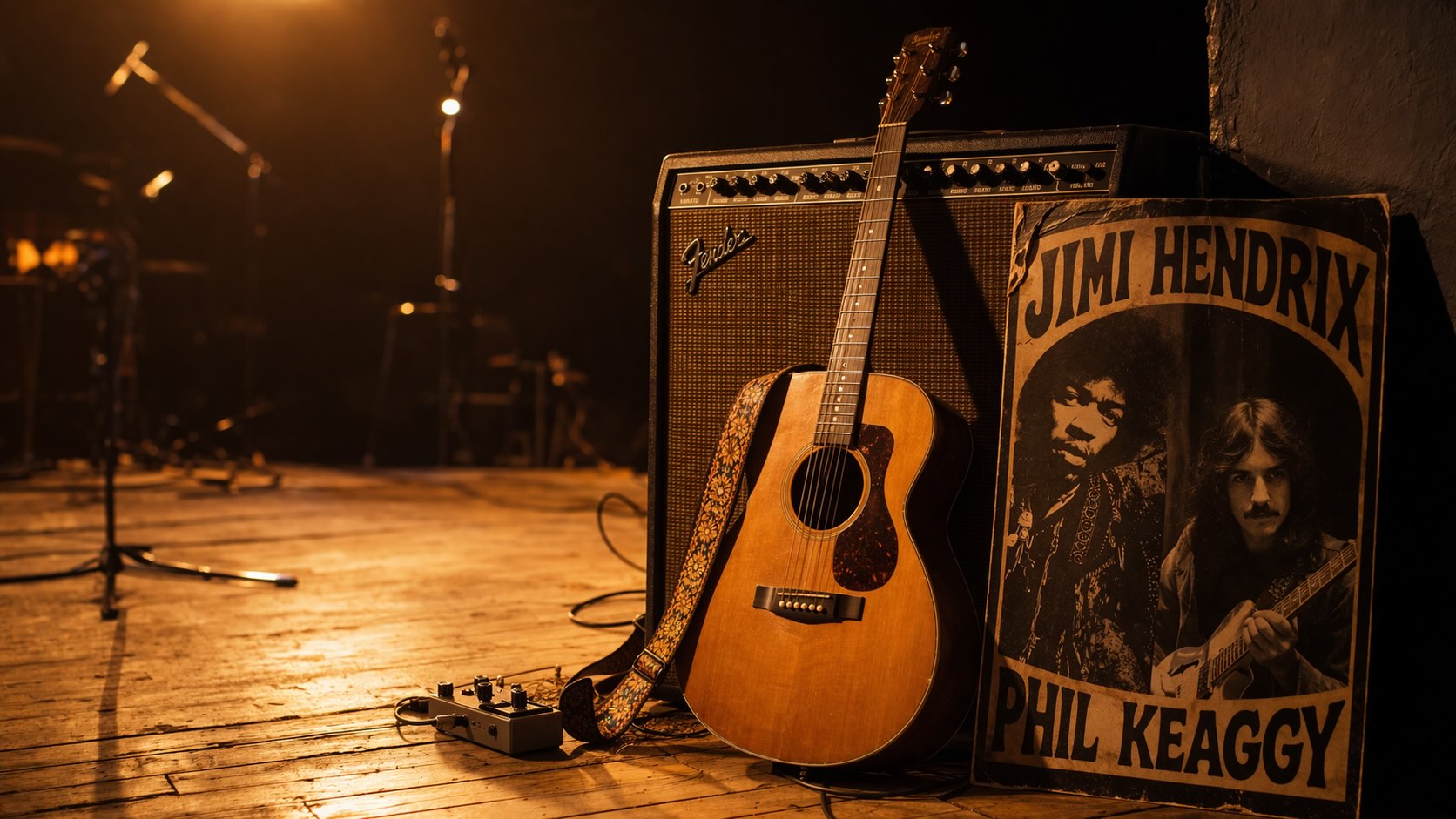

If you’ve spent any time in Christian music circles or guitar forums, you’ve probably heard this story:
Someone once asked Jimi Hendrix — or sometimes it’s Eric Clapton — “How does it feel to be the greatest guitarist in the world?” The rock legend supposedly replied, “I don’t know. Go ask Phil Keaggy.”
It’s a great story. It validates Christian music. It suggests that secular rock icons secretly acknowledged a believer as their superior. The only problem? It never happened.
But here’s what’s interesting: the myth has persisted for decades, and it refuses to die. Why? Because even though the quote is fabricated, the sentiment behind it isn’t entirely wrong. Phil Keaggy really is one of the most gifted guitarists who ever lived — and most people outside Christian music have never heard of him.
Let’s separate fact from fiction and discover who Phil Keaggy actually is.
The Myth: What People Claim Was Said
The legend has circulated since at least the 1980s. The details shift depending on who’s telling it:
Version 1: Jimi Hendrix was asked in an interview, “How does it feel to be the best guitarist in the world?” He replied, “I don’t know. Ask Phil Keaggy.”
Version 2: Eric Clapton was asked the same question and gave the same answer.
Version 3: A journalist asked multiple guitar legends who the best guitarist was, and they all pointed to Phil Keaggy.
The quote appears on countless Christian websites, gets shared in church bulletins, and circulates endlessly on social media. It sounds authoritative. It feels true. People want it to be true.
But it isn’t.
The Truth: Phil Keaggy’s Own Response
Phil Keaggy himself has addressed this myth multiple times over the years. In an interview with WORLD Magazine, he was asked directly about the legend:
“I’ve heard that story before. Actually, the myth is more popular than I am, the urban legend that it is. No, it was never said by either of them.”
Keaggy has been gracious about the whole thing, even finding some humour in it. He acknowledges that the story persists because people want to believe it — and because, frankly, his guitar playing is genuinely exceptional.
In the same interview, he reflected on what Hendrix actually said when asked about being the greatest:
“When Jimi Hendrix was asked the question, ‘How does it feel to be the greatest player in the world?’ He goes, ‘Let’s just say I’m the greatest guitar player in this chair.’ He was pretty modest and humble about his own assessment of himself.”
There’s no historical record of Hendrix or Clapton ever mentioning Phil Keaggy. No interview transcript, no video clip, no contemporaneous report. The quote appears to have originated in Christian circles and spread from there.
Why the Myth Persists
If the quote is false, why won’t it die? Several factors keep it alive:
It Validates Christian Music
For decades, Christian musicians have struggled for mainstream recognition. The Contemporary Christian Music industry exists largely separate from the secular music world. Christian artists rarely win Grammys in mainstream categories. Radio stations don’t play worship songs alongside pop hits.
The Hendrix quote, if true, would mean that even the secular world’s greatest acknowledged a Christian as superior. It would validate the entire enterprise of Christian music. That’s a powerful emotional pull.
Phil Keaggy Actually Is Extraordinary
The myth works because it’s plausible. Anyone who has heard Phil Keaggy play knows he belongs in the conversation with the world’s greatest guitarists. His technical ability, creativity, and musicality are undeniable.
Rolling Stone magazine named him one of the “25 Most Underrated Guitarists” — a list that included Prince, George Harrison, Kurt Cobain, and Neil Young. Guitar Player magazine readers voted him one of the top fingerstyle guitarists multiple years running. Ted Nugent, guitarist for the Amboy Dukes, was quoted saying: “I don’t know what happened to that Phil Keaggy. He could have saved the world with his guitar.”
So while Hendrix never said “ask Phil Keaggy,” plenty of respected guitarists have praised him genuinely.
Christians Love an Underdog Story
There’s something appealing about a narrative where the world’s best is hidden away in Christian music, unrecognised by the masses but acknowledged by those who truly know. It fits a biblical template: God choosing the foolish to shame the wise, the last being first, treasure hidden in a field.
The myth taps into that narrative instinct. Even though it’s false, it feels spiritually true.
Who Is Phil Keaggy, Really?
Setting aside the myth, let’s look at the actual man — because his real story is more interesting than the legend.
Early Life and the Missing Finger
Philip Tyler Keaggy was born on March 23, 1951, in Youngstown, Ohio — the ninth of ten children in a musical household. He started playing guitar as a young boy and showed extraordinary talent early.
At age four, Keaggy suffered an accident that would have ended most guitar careers before they began. He lost the middle finger on his right hand. For a guitarist, this is devastating — that finger is crucial for fingerpicking techniques.
Instead of giving up, Keaggy adapted. He developed a unique fingerpicking style using his remaining fingers that became his trademark. What could have been a career-ending disability became part of what makes his playing distinctive.
Glass Harp: Mainstream Success
In the late 1960s, Keaggy co-founded Glass Harp, a power trio that gained significant attention in the mainstream rock world. They toured extensively, opened for major acts, and even recorded a live album at Carnegie Hall.
Glass Harp was on the verge of major commercial breakthrough. Record labels were interested. The future looked bright in mainstream rock.
Then everything changed.
Conversion to Christianity
In 1970, Phil Keaggy became a Christian. The timing was significant — it happened just one week after his mother died in a car accident. He was in a “tender place,” as he later described it, grieving and searching for meaning.
On the day of his conversion, Keaggy went home and searched through his record collection for something to match his spiritual experience. He landed on Eric Clapton’s “Presence of the Lord” from the Blind Faith album.
The lyrics resonated: “I have finally found a place to live, just like I never could before… in the presence of the Lord.”
From that point forward, Keaggy’s faith would shape everything about his music.
Leaving Mainstream for Christian Music
Keaggy faced a choice. He could continue pursuing mainstream success with Glass Harp, or he could dedicate his music to his newfound faith. He chose faith.
This decision cost him commercially. Christian music in the 1970s was a tiny niche market. There was no infrastructure, no radio play, no major label support. Albums sold primarily through Christian bookstores. Mainstream audiences never heard his work.
Keaggy has reflected on this with characteristic humility:
“CCM never really understood me. I’m not sure that CCM understands what I’m trying to do today. It doesn’t matter anymore.”
He exists in an unusual space — too skilled and experimental for much of the Christian market, yet committed to faith-based content that limits mainstream exposure.
A Remarkable Career
Despite the commercial limitations, Keaggy’s output has been staggering:
- 60+ solo albums spanning rock, folk, instrumental, ambient, and worship music
- 7 Dove Awards from the Gospel Music Association
- Grammy nominations for his instrumental work
- Induction into the Gospel Music Hall of Fame in 2007
- Rolling Stone’s “25 Most Underrated Guitarists” recognition
He pioneered live looping techniques that are now standard among acoustic performers. He collaborated with countless artists across genres. He developed a devoted following among guitarists who recognise his genius even if the general public doesn’t.
In 2024, Keaggy joined forces with keyboardist Neal Morse, drummer Chester Thompson (known for Weather Report and touring with Genesis), and bassist Byron House to form Cosmic Cathedral. Their album “Deep Water” released in 2025 represents yet another chapter in a career spanning over five decades.
What Phil Keaggy Says About Greatness
Perhaps the most telling aspect of this whole myth is how Keaggy himself handles questions about being “the greatest.”
When interviewers press him on the topic, he deflects with genuine humility:
“Anybody who is a true musician knows they’re not the greatest at anything… The closer you are to the Lord, the more you realise what a sinner you might really, truly be. The closer you get to becoming a great writer, the more you realise how little you know. I’ve always had a pretty realistic assessment of my own gifts and talents. I also know my limitations.”
This humility isn’t false modesty. It reflects a theological understanding that all gifts come from God and should be used for His glory rather than personal aggrandisement.
When asked if he might be the best guitarist in the world, Keaggy responded simply:
“I’m certainly one of the guitar players in the world, that’s for sure.”
The Real Lesson
The Hendrix quote is a myth. But the underlying question it raises is worth considering: What does it mean to use extraordinary gifts for God’s purposes rather than worldly fame?
Phil Keaggy could have pursued mainstream stardom. He had the talent. He had the early momentum. He made a different choice — not because Christian music was easier or more lucrative (it wasn’t), but because he believed his gifts should serve a higher purpose.
Whether you think that was the right decision depends on your values. But there’s something compelling about a man with world-class abilities choosing a smaller stage because he believed it mattered more.
The myth says Hendrix acknowledged Keaggy as the greatest. The truth is more interesting: Keaggy didn’t need Hendrix’s validation. He found something he valued more.
A Prayer for Those With Hidden Gifts
Father, You give gifts to Your children — some visible to the world, some known only to a few. Help us to steward what You’ve given faithfully, whether we receive recognition or not.
Thank You for artists like Phil Keaggy who use extraordinary talent for Your glory rather than their own fame. May their example challenge us to examine our own motives and priorities.
Remind us that faithfulness matters more than fame, and that an audience of One is enough.
In Jesus’ name, Amen.