Bible Characters: Who's Who in the Bible, From Adam to Paul
A guide to the major Bible characters in the order the story unfolds, from Adam to Paul, with a short story, Bible chapters and a lesson for each, plus the 12 apostles.
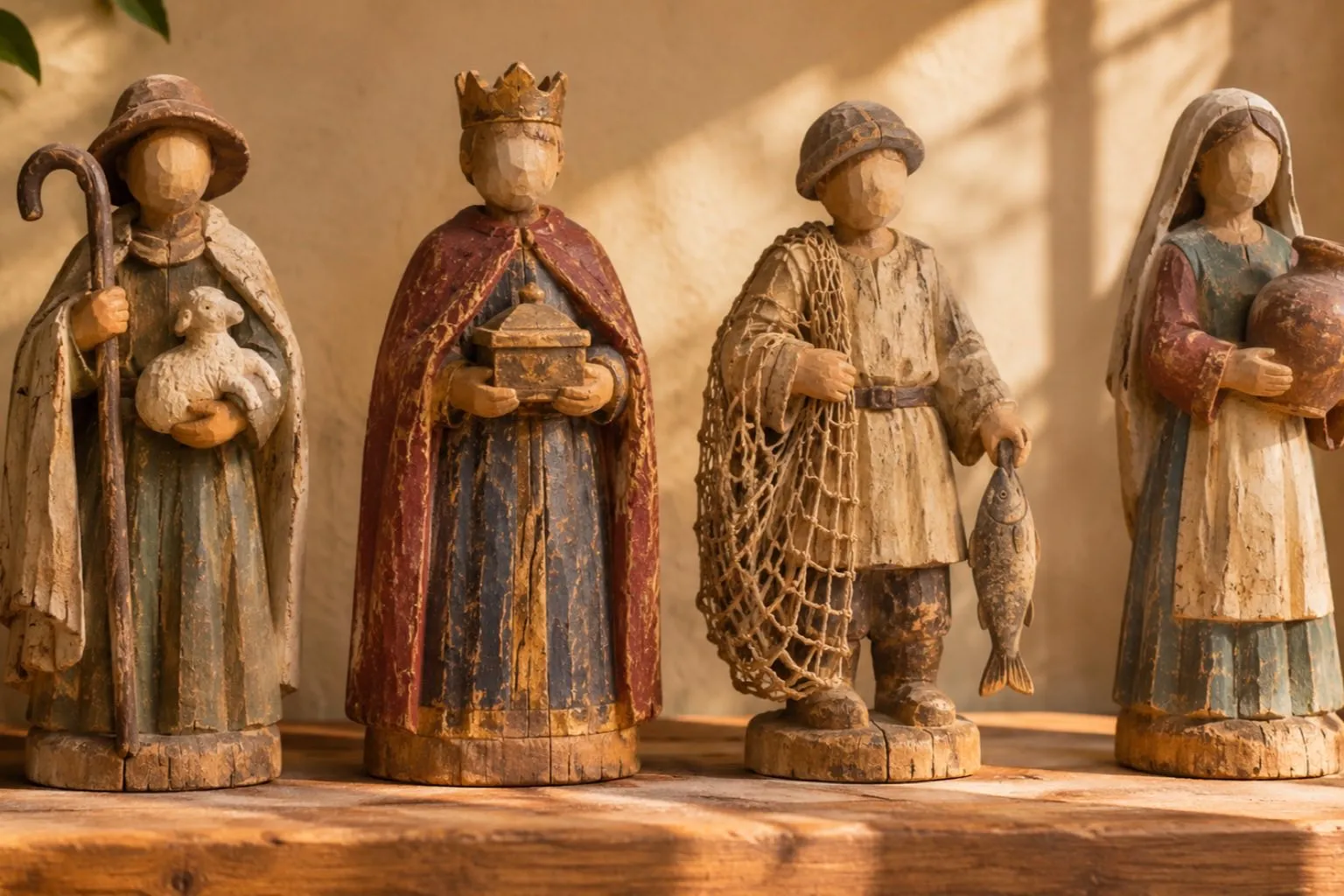
The major Bible characters are the people God worked through as his story moved from creation to the early church: Adam and Eve, Noah, Abraham, Moses, David, the prophets, Jesus and his apostles, and Paul. Below you will find each one in the order the story unfolds, with who they were, what happened, where to read it, and one lesson for today. Jesus stands at the center of them all, because the whole Bible points to him.
This guide covers the people you will meet most often in sermons and Sunday school. For the women of Scripture in more depth, see our separate guide to women in the Bible.
Bible characters at a glance
- The beginning: Adam, Eve, Noah
- The patriarchs: Abraham, Isaac, Jacob, Joseph
- The exodus and conquest: Moses, Aaron, Joshua
- The judges: Deborah, Gideon, Samson, Ruth, Samuel
- The kings: Saul, David, Solomon, Hezekiah, Josiah
- The prophets: Elijah, Elisha, Jonah, Isaiah, Jeremiah, Daniel
- Exile and return: Esther, Ezra, Nehemiah
- The Gospels: Mary, John the Baptist, Jesus, Peter, John, Judas Iscariot, Mary Magdalene, Nicodemus, Pontius Pilate
- The early church: Stephen, Paul, Barnabas, Timothy, Priscilla and Aquila
The beginning: Adam, Eve and Noah
Adam
Who: The first man, formed by God from the dust of the ground. God placed Adam in Eden to care for the garden and name the animals. When he and Eve ate from the one forbidden tree, sin and death entered the world. Paul later contrasts Adam with Jesus: death came through one man, and life comes through another (Romans 5).
Read: Genesis 1 to 5. Lesson: Every person shares Adam's need for a Savior.
Eve
Who: The first woman, made as Adam's partner. Eve listened to the serpent, ate the forbidden fruit and gave some to Adam. Even while judging their sin, God promised that her offspring would crush the serpent's head (Genesis 3:15), which Christians read as the first promise of Christ.
Read: Genesis 2 to 4. Lesson: Temptation often starts by questioning what God has said.
Noah
Who: A righteous man in a violent generation. God told Noah to build an ark to save his family and the animals from a great flood, and Noah did everything God commanded. Afterward God promised never again to destroy the earth by flood and set the rainbow as the sign.
Read: Genesis 6 to 9. Lesson: Quiet obedience matters, even when no one else understands it.
The patriarchs: Abraham, Isaac, Jacob and Joseph
The patriarchs are the founding fathers of Israel. God's promises to them shape the rest of the Bible.
Abraham
Who: The father of the Jewish people and, Paul says, of all who believe. God called Abram (later Abraham) to leave his home for a land God would show him, promising to bless all the families of the earth through him. He waited about twenty-five years for his son Isaac. Later God tested him by asking him to offer Isaac, then provided a ram instead.
Read: Genesis 12 to 25. Lesson: Faith trusts God's promise before it can see it (Genesis 15:6).
Genesis 12:1-2 — "Now Yahweh said to Abram, “Get out of your country, and from your relatives, and from your father’s house, to the land that I will show you. I will make of you a great nation. I will bless you and make your name great. You will be a blessing.”"
Isaac
Who: Abraham and Sarah's son, the child of promise. Isaac was the boy laid on the altar and spared. He married Rebekah and fathered twins, Esau and Jacob. His life was quieter than his father's.
Read: Genesis 21 to 28. Lesson: Not every faithful life is dramatic.
Jacob
Who: Isaac's younger son, renamed Israel. Jacob took Esau's birthright and tricked their father into blessing him. Years later he wrestled through the night with God and came away limping, with a new name. His twelve sons became the twelve tribes of Israel.
Read: Genesis 25 to 35. Lesson: God works with flawed people and slowly changes them.
Joseph
Who: Jacob's favorite son, sold into slavery by his brothers. In Egypt Joseph was falsely accused and imprisoned, then raised to second in command after interpreting Pharaoh's dreams. He stored grain before a famine, and when his brothers came for food, he forgave them: you meant evil, but God meant it for good (Genesis 50:20).
Read: Genesis 37 to 50. Lesson: God can use even betrayal for good. See our sermon on forgiveness.
The exodus and conquest: Moses, Aaron and Joshua
Jacob's family grew into a nation enslaved in Egypt. Christians differ on the date of the exodus, but not on its point: God rescued his people.
Moses
Who: The prophet who led Israel out of Egypt. Hidden as a baby in a basket on the Nile, Moses was raised in Pharaoh's household. God called him from a burning bush, then sent the plagues, the Passover and the crossing of the Red Sea. At Mount Sinai God gave the Ten Commandments through him, and after forty years in the wilderness he died on Mount Nebo, within sight of the promised land.
Read: Exodus 2 to 40, Numbers, Deuteronomy 34. Lesson: God calls people who feel unqualified (Exodus 4:10-12).
Aaron
Who: Moses' older brother and Israel's first high priest. Aaron spoke for Moses before Pharaoh, and God set him and his sons apart as priests. Yet while Moses was on the mountain, Aaron gave in to the crowd and made a golden calf.
Read: Exodus 4 to 32, Leviticus 8, Numbers 20. Lesson: Leaders fail, but Jesus is the high priest who never fails (Hebrews 4 to 7).
Joshua
Who: Moses' assistant and successor. Joshua and Caleb were the only spies who trusted God to give Israel the land. After Moses died, Joshua led the people across the Jordan, saw the walls of Jericho fall and divided the land. He told Israel: as for me and my house, we will serve the Lord (Joshua 24:15).
Read: Numbers 13 to 14 and Joshua 1 to 24. Lesson: Courage comes from God's presence.
Joshua 1:9 — "Haven’t I commanded you? Be strong and courageous. Don’t be afraid, neither be dismayed: for Yahweh your God is with you wherever you go.”"
The judges: Deborah, Gideon, Samson, Ruth and Samuel
After Joshua, Israel fell into a cycle of sin, oppression and rescue, as God raised up judges to deliver them.
Deborah
Who: A prophetess who judged Israel. Deborah held court under a palm tree. She summoned Barak to fight the Canaanite commander Sisera and went with him when he would not go alone. Israel won, and she sang a song of victory.
Read: Judges 4 to 5. Lesson: God uses whoever is willing.
Gideon
Who: An unlikely farmer God chose to defeat Midian. Gideon was hiding in a winepress when the angel of the Lord called him. He asked for signs with a fleece, then watched God shrink his army to three hundred men, who routed the enemy with trumpets, jars and torches.
Read: Judges 6 to 8. Lesson: God's strength shows best through our weakness.
Samson
Who: A Nazirite judge with great strength. Samson fought the Philistines but was ruled by his appetites. Delilah betrayed the secret of his strength, and he was blinded. In his last act he prayed for strength and brought down the temple of Dagon.
Read: Judges 13 to 16. Lesson: Gifts are no substitute for character, yet Hebrews 11 still lists Samson among the faithful.
Ruth
Who: A Moabite widow who joined God's people. Set in the days of the judges, Ruth's story begins when she refuses to leave her mother-in-law Naomi: your people will be my people, and your God my God. She married Boaz, her kinsman-redeemer, and became the great-grandmother of King David.
Read: Ruth 1 to 4. Lesson: God welcomes outsiders and honors quiet loyalty.
Samuel
Who: The last judge and a prophet. Samuel was born after his mother Hannah prayed for a son, and he grew up serving at the tabernacle. As a boy he heard God call him in the night. He led Israel for years and anointed both Saul and David.
Read: 1 Samuel 1 to 16. Lesson: Listening to God comes before speaking for him.
The kings: Saul, David, Solomon and beyond
Israel asked for a king like the other nations. The kingdom peaked under David and Solomon, then split in two.
Saul
Who: Israel's first king. Saul was tall and impressive, but he disobeyed God's clear commands, and Samuel told him that to obey is better than sacrifice. He spent his last years hunting David and died in battle on Mount Gilboa.
Read: 1 Samuel 9 to 31. Lesson: Outward strength cannot replace an obedient heart.
David
Who: A shepherd boy who became Israel's greatest king. The youngest son of Jesse, David was anointed by Samuel, killed Goliath and became king around 1000 BC, making Jerusalem his capital. He sinned with Bathsheba and arranged her husband's death, but repented when Nathan confronted him. God promised that his throne would last forever, a promise fulfilled in Jesus, the Son of David.
Read: 1 Samuel 16 to 1 Kings 2, and many Psalms, including Psalm 51. Lesson: God looks at the heart. See our sermon on David and Goliath.
1 Samuel 16:7 — "But Yahweh said to Samuel, “Don’t look on his face, or on the height of his stature; because I have rejected him: for I see not as man sees; for man looks at the outward appearance, but Yahweh looks at the heart.”"
Solomon
Who: David's son, the wise king who built the temple. Solomon asked God for wisdom, and God gave him wealth as well. He built the first temple in Jerusalem, but his many foreign wives turned his heart to other gods, and after his death the kingdom split into Israel and Judah.
Read: 1 Kings 1 to 11. Lesson: A good start does not guarantee a good finish.
Two later kings of Judah also stand out. Hezekiah trusted God when Assyria besieged Jerusalem, and the city was spared (2 Kings 18 to 20). Josiah became king at eight; when the Book of the Law was found in the temple, he led the nation in repentance (2 Kings 22 to 23).
The prophets: Elijah, Elisha, Jonah, Isaiah, Jeremiah and Daniel
Prophets spoke God's word to kings and people and looked ahead to the Messiah.
Elijah
Who: A prophet in the days of King Ahab and Queen Jezebel. On Mount Carmel Elijah challenged 450 prophets of Baal, and God answered with fire. Then, exhausted, he fled from Jezebel, and God met him gently with rest, food and a quiet voice. He was taken to heaven in a whirlwind.
Read: 1 Kings 17 to 2 Kings 2. Lesson: Great faith and deep discouragement can live in the same person.
Elisha
Who: Elijah's successor. Elisha asked for a double portion of Elijah's spirit. His miracles were mostly mercies: oil for a poor widow, a boy raised to life, and the healing of Naaman, a Syrian commander with leprosy.
Read: 2 Kings 2 to 13. Lesson: God's work passes faithfully from one generation to the next.
Jonah
Who: A prophet who ran from God's call. Jonah served in the time of King Jeroboam II (2 Kings 14:25). Sent to Nineveh, Israel's enemy, he sailed the other way and was swallowed by a great fish. When he finally preached, Nineveh repented, and Jonah sulked at God's mercy.
Read: Jonah 1 to 4. Lesson: God's mercy is wider than our prejudices. Jesus pointed to the sign of Jonah (Matthew 12:39-41).
Isaiah
Who: A prophet to Judah in the days of Hezekiah and earlier kings. Isaiah saw the Lord in the temple and answered, here I am, send me. His book holds some of the clearest prophecies of Christ, including Immanuel (Isaiah 7:14) and the suffering servant (Isaiah 53).
Read: Isaiah, especially chapters 6, 9 and 53. Lesson: Seeing God's holiness leads to humble service.
Jeremiah
Who: Often called the weeping prophet. Jeremiah warned Judah for about forty years until Babylon destroyed Jerusalem in 586 BC. He was beaten, imprisoned and dropped into a muddy cistern, yet he announced a new covenant written on people's hearts (Jeremiah 31:31-34).
Read: Jeremiah and Lamentations. Lesson: Faithfulness is measured by obedience, not visible success.
Daniel
Who: A young Jew taken to Babylon who served foreign kings. Daniel interpreted Nebuchadnezzar's dreams and read the writing on the wall, while his friends survived the fiery furnace. When prayer to anyone but the king was banned, Daniel kept praying three times a day, was thrown to the lions, and God shut their mouths.
Read: Daniel 1 to 12. Lesson: You can serve faithfully in a culture that does not share your faith.
Exile and return: Esther, Ezra and Nehemiah
Babylon destroyed Jerusalem in 586 BC. After Persia conquered Babylon, King Cyrus let the Jews go home in 538 BC (Ezra 1).
Esther
Who: A Jewish orphan who became queen of Persia. Raised by her cousin Mordecai, Esther became the wife of King Ahasuerus, usually identified as Xerxes I. When Haman plotted to destroy the Jews, she went to the king uninvited, risking her life: if I perish, I perish. Her people were saved, and the feast of Purim remembers it.
Read: Esther 1 to 10. Lesson: God is at work even when he seems hidden. The book never names him.
Esther 4:14 — "For if you remain silent now, then relief and deliverance will come to the Jews from another place, but you and your father’s house will perish. Who knows if you haven’t come to the kingdom for such a time as this?”"
Ezra
Who: A priest and scribe who led exiles back to Jerusalem. Ezra returned in the reign of Artaxerxes, having set his heart to study God's law, do it and teach it (Ezra 7:10). Later he read the law aloud to the gathered people.
Read: Ezra 7 to 10 and Nehemiah 8. Lesson: Renewal begins with hearing and obeying God's word.
Nehemiah
Who: Cupbearer to the Persian king, then governor of Judah. Hearing that Jerusalem's walls lay in ruins, Nehemiah wept and prayed, then asked the king to send him. Despite threats and mockery, the people rebuilt the wall in fifty-two days.
Read: Nehemiah 1 to 13. Lesson: Prayer and hard work belong together.
The Gospels: Jesus and the people around him
About four hundred years after the last Old Testament prophets, the Gospels of Matthew, Mark, Luke and John tell the story of Jesus.
Mary, the mother of Jesus
Who: A young woman from Nazareth, engaged to Joseph. The angel Gabriel told Mary she would bear the Son of God, and she answered that she was the Lord's servant. She gave birth in Bethlehem and stood near the cross. Catholic, Orthodox and Protestant Christians honor her in different ways, but all recognize her faith.
Read: Luke 1 to 2, John 19, Acts 1:14. Lesson: Saying yes to God can be costly, and it is worth it.
John the Baptist
Who: A prophet and relative of Jesus. John preached repentance in the wilderness and baptized Jesus in the Jordan. He pointed his own followers to Jesus: he must increase, but I must decrease (John 3:30). Herod Antipas later had him beheaded.
Read: Luke 1, Matthew 3 and 14, John 1. Lesson: Our best work is pointing others to Jesus.
John 1:29 — "The next day, he saw Jesus coming to him, and said, “Behold, the Lamb of God, who takes away the sin of the world!”"
Jesus
Who: The Son of God, fully God and fully man, the promised Messiah. Born in Bethlehem and raised in Nazareth, Jesus began his ministry around age thirty, teaching, healing and calling disciples. He was crucified under Pontius Pilate, rose on the third day and ascended to the Father, and he promised to return.
Read: Matthew, Mark, Luke and John. Lesson: Everything in the Bible leads here. See the names of Jesus.
Peter
Who: A Galilean fisherman, also called Simon, leader of the twelve. Peter was the first to confess Jesus as the Christ, then denied him three times on the night of his arrest. The risen Jesus restored him, and at Pentecost Peter preached and about three thousand people were baptized.
Read: The Gospels, Acts 1 to 12, 1 and 2 Peter. Lesson: Failure is not final with Jesus.
Matthew 16:16 — "Simon Peter answered, “You are the Christ, the Son of the living God.”"
John the apostle
Who: A fisherman, son of Zebedee, brother of James. John was one of Jesus' three closest disciples and is traditionally identified as the disciple whom Jesus loved. At the cross Jesus entrusted his mother to him. Tradition credits him with the Gospel of John, three letters and Revelation.
Read: The Gospels, Acts 3 to 4, 1 to 3 John. Lesson: Love for God and love for others go together.
Judas Iscariot
Who: The apostle who betrayed Jesus. Judas kept the disciples' money bag and stole from it (John 12:6). He handed Jesus over for thirty pieces of silver, identifying him with a kiss. Afterward, full of remorse, he took his own life.
Read: Matthew 26 to 27, Acts 1. Lesson: Being near Jesus is not the same as trusting him.
Mary Magdalene
Who: A follower whom Jesus freed from seven demons. She supported Jesus' ministry, stayed at the cross and went to the tomb on Easter morning, where the risen Jesus appeared to her first. The idea that she was a prostitute comes from later tradition, not the Bible.
Read: Luke 8:2, John 19 to 20. Lesson: Jesus trusted her with the first Easter news. See Bible verses about the resurrection.
Nicodemus
Who: A Pharisee on the Jewish ruling council. Nicodemus came to Jesus at night and heard that he must be born again. Later he defended Jesus' right to a fair hearing, and after the crucifixion he helped bury him.
Read: John 3, 7:50-51 and 19:38-42. Lesson: Honest questions can lead to open faith.
Pontius Pilate
Who: The Roman governor of Judea from about AD 26 to 36. Pilate found no basis for a charge against Jesus but handed him over to be crucified anyway, then washed his hands before the crowd. A stone bearing his name and title, found at Caesarea in 1961, confirms he was a real governor. Christians still name him in the Apostles' Creed.
Read: Matthew 27, John 18 to 19. Lesson: Washing your hands of Jesus is still a decision.
The early church: Stephen, Paul, Barnabas, Timothy, Priscilla and Aquila
The book of Acts tells how the gospel spread from Jerusalem to Rome after Pentecost.
Stephen
Who: One of seven men chosen to serve the church's widows. Stephen spoke boldly about Jesus before the council, and they stoned him. He died praying for his killers to be forgiven, while a young man named Saul approved.
Read: Acts 6 to 7. Lesson: The first Christian martyr forgave his enemies, as Jesus did.
Paul
Who: Saul of Tarsus, a Pharisee who persecuted the church. The risen Jesus met Saul on the road to Damascus and called him to take the gospel to the Gentiles. He planted churches across the Roman world and reached Rome as a prisoner. Thirteen New Testament letters bear his name.
Read: Acts 9 and 13 to 28, Romans to Philemon. Lesson: No one is beyond grace. See our sermon on grace.
Acts 9:15 — "But the Lord said to him, “Go your way, for he is my chosen vessel to bear my name before the nations and kings, and the children of Israel.”"
Barnabas
Who: A Levite from Cyprus, nicknamed son of encouragement. When believers feared the newly converted Saul, Barnabas vouched for him. The two traveled together on the first mission to the Gentiles, then parted over John Mark.
Read: Acts 4:36-37, 9:27 and 11 to 15. Lesson: Encouragers change history.
Timothy
Who: Paul's young co-worker from Lystra. Timothy learned the Scriptures from his mother Eunice and grandmother Lois, traveled with Paul and later led the church in Ephesus. Paul told him not to let anyone look down on him for being young.
Read: Acts 16, 1 and 2 Timothy. Lesson: Faith passed down at home can shape a ministry.
Priscilla and Aquila
Who: A married couple of tentmakers who worked with Paul. Expelled from Rome under Claudius, they met Paul in Corinth. They took the preacher Apollos aside and explained the way of God more accurately, and a church met in their home.
Read: Acts 18, Romans 16:3-5. Lesson: Ordinary homes and jobs can become places of ministry.
Who is the most important character in the Bible?
Jesus is the most important character in the Bible. The Old Testament prepares for him through promises, sacrifices, kings and prophets, and the New Testament tells of his life, death and resurrection and what it means. After he rose, Jesus himself walked two disciples through the Scriptures to show them this.
Luke 24:27 — "Beginning from Moses and from all the prophets, he explained to them in all the Scriptures the things concerning himself."
Adam, Moses, David and Jonah all foreshadow him, and God's promises to Abraham and David are fulfilled in him. So read every Bible character asking both what they teach and how they lead to Christ. See also our sermon on salvation. For more teaching on Bible people and stories, browse our sermon outlines, including the prodigal son and good Samaritan.
Who are the 12 apostles?
The twelve apostles are listed four times in the New Testament: Matthew 10:2-4, Mark 3:16-19, Luke 6:14-16 and Acts 1:13. A few have more than one name.
- Simon Peter, also called Cephas.
- Andrew, Peter's brother.
- James son of Zebedee, the first apostle to be martyred (Acts 12:2).
- John, James's brother.
- Philip, from Bethsaida.
- Bartholomew, often identified with Nathanael in John's Gospel.
- Thomas, also called Didymus, meaning twin.
- Matthew, the tax collector, also called Levi.
- James son of Alphaeus.
- Thaddaeus, called Judas son of James in Luke and Acts, and Judas (not Iscariot) in John 14:22.
- Simon the Zealot, called Simon the Cananaean in some translations of Matthew and Mark.
- Judas Iscariot, who betrayed Jesus. After his death the apostles chose Matthias to take his place (Acts 1:26).
Paul was also an apostle, called by the risen Jesus, but not one of the original twelve.
Bible characters for kids
- Noah built a big boat because God told him to, and God kept his family and the animals safe.
- Abraham trusted God and moved to a new land, and God gave him a son when he was very old.
- Joseph was sold by his brothers, but God took care of him, and he forgave them.
- Moses led God's people out of Egypt, and God opened a path through the sea.
- David was a shepherd boy who trusted God and beat a giant named Goliath.
- Daniel kept praying to God, and God kept him safe in a den of lions.
- Jonah ran away from God, was swallowed by a big fish, and learned that God loves everyone.
- Jesus is God's Son, who loves children, died for our sins and rose again.
FAQ
How many characters are in the Bible?
The Bible names roughly 3,000 people. Reference works give counts from about 3,200 to 3,400, depending on how they treat people who share a name.
Who was the first person in the Bible?
Adam was the first person, made by God from the dust of the ground in Genesis 2. Eve was the first woman, made as his partner. Their story is told in Genesis 1 to 5.
Who was the oldest person in the Bible?
Methuselah was the oldest person in the Bible. Genesis 5:27 says he lived 969 years. He was the grandfather of Noah.
Who wrote most of the New Testament?
Paul wrote the most books, with thirteen letters bearing his name. Luke wrote the most words, through his Gospel and the book of Acts. Some scholars question whether Paul wrote all thirteen letters, but the church has traditionally received them as his.