Prathia Hall: The Preacher Whose Prayer Gave America a Dream
Prathia Hall was a civil rights worker, Baptist pastor and scholar whose 1962 prayer is said to have given Martin Luther King Jr. the words "I have a dream." Here is her story.
Prathia Hall is one of the most important preachers most Christians have never heard of. She was shot at for registering voters, prayed a prayer that may have shaped the best-known speech in American history, and went on to become a pastor, a scholar and a teacher of preachers. Here at Higher Praise, we think her story deserves to be told plainly.
The Short Answer: Who Was Prathia Hall?
Prathia Hall (1940–2002) was a Baptist minister, a civil rights worker with the Student Nonviolent Coordinating Committee (SNCC), and a seminary professor. She was raised in Philadelphia, served in the voting rights campaigns of Southwest Georgia and Selma in the early 1960s, was ordained by the American Baptist Churches USA, pastored Mount Sharon Baptist Church in Philadelphia, and finished her career holding the Martin Luther King Jr. Chair in Social Ethics at Boston University School of Theology.
A Preacher's Daughter From Philadelphia
Prathia Laura Ann Hall was born on January 1, 1940, and grew up in Philadelphia. Her father, Berkeley Hall, was a Baptist minister who founded and pastored Mount Sharon Baptist Church. She grew up in a home where faith and justice were not two subjects but one, and she later gave that conviction a name: "freedom faith." Her biographer, Courtney Pace, describes it as the belief that God wants all people to be free and equips those who work for freedom.
That idea is not a slogan. It comes straight out of Scripture.
2 Corinthians 3:17 — "Now the Lord is the Spirit and where the Spirit of the Lord is, there is liberty."
Hall studied at Temple University. While still a student she was arrested at a protest on Maryland's Eastern Shore and, according to the SNCC Legacy Project, held for two weeks without bail. It would not be her last time in a jail cell.
Prathia Hall in Southwest Georgia
In 1962 Hall went south to join SNCC's project in Albany, Georgia, working under Charles Sherrod. She was sent to Terrell County, a place so dangerous for Black citizens who tried to vote that movement workers called it "Terrible Terrell." She lived in the home of a local woman, Carolyn Daniels, in the town of Dawson, and went door to door asking people to register.
On the night of September 6, 1962, night riders fired into the Daniels house. Hall and two other workers, Jack Chatfield and Christopher Allen, were wounded. Three days later, before dawn on Sunday, September 9, Mount Olive Baptist Church in Terrell County was burned to the ground. SNCC's own records say Hall and others stood and watched it burn, and no firefighters came.
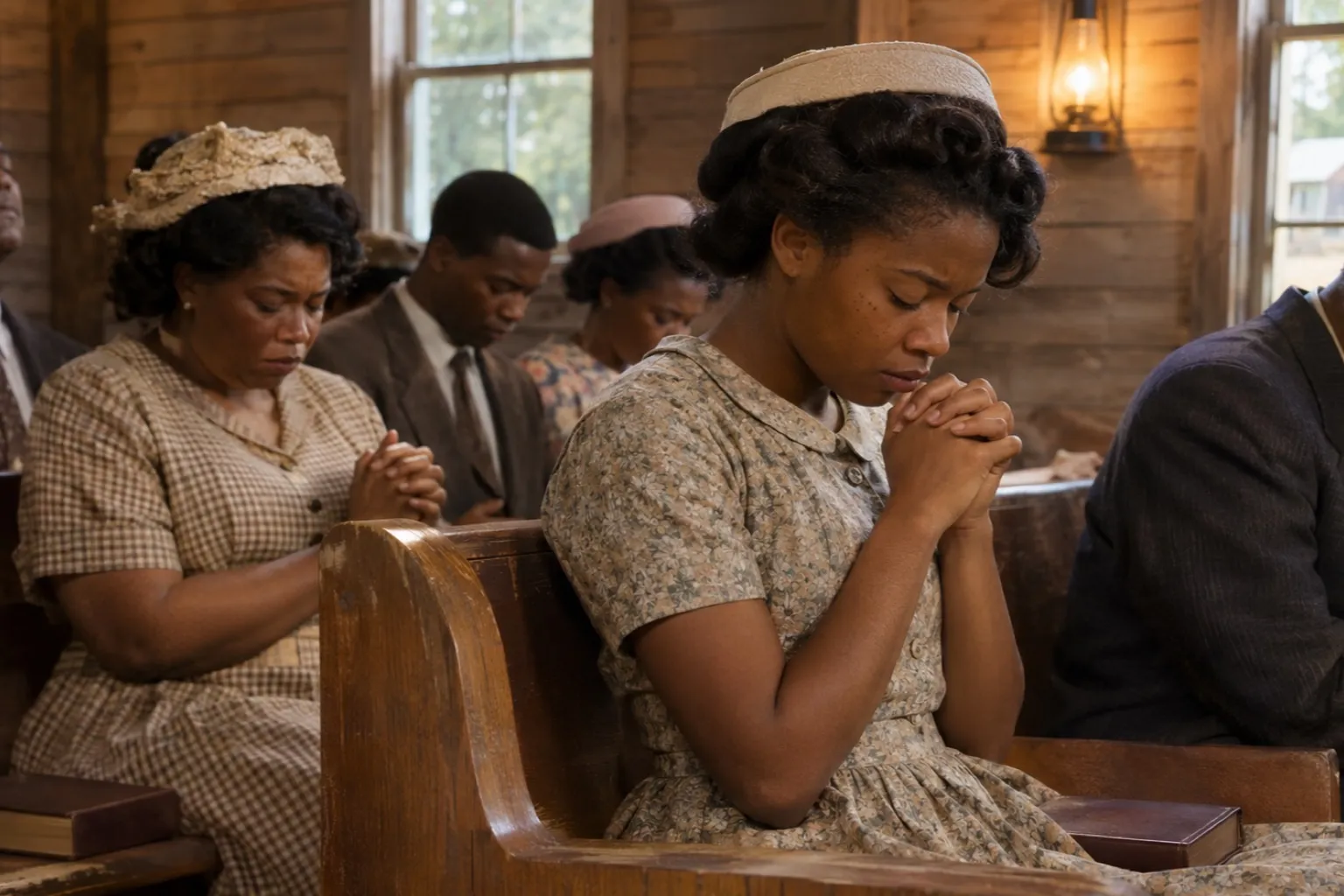
Hall later described what held people together in those weeks. The prayers and songs of the mass meetings, she said, "fashioned fear into faith."
Galatians 5:1 — "Stand firm therefore in the liberty by which Christ has made us free, and don’t be entangled again with a yoke of bondage."
The Prayer and the Phrase "I Have a Dream"
After the church burnings, a prayer service was held in Terrell County. Prathia Hall, then twenty-two years old, was asked to pray. According to her biographer, she prayed aloud about her vision for the future and repeated one phrase again and again: "I have a dream."
Martin Luther King Jr. is said to have been at that service. Pace writes that King asked Hall, on the ride to the airport, for her permission to use the phrase. Another movement leader, James Bevel, is also reported to have said that King took the phrase from her prayer.
We want to be careful here, because the claim is often repeated as a settled fact and it is not quite that. It rests on the accounts of people who were there, passed on years later. Pace's own scholarly wording is that there is "evidence that" Hall originated the phrase. The King Institute at Stanford traces King's dream language through his own sermons and a June 1963 rally in Detroit, and does not mention Hall. The fairest way to say it is this: according to those who knew them both, King heard a young woman pray those words in a burned-out corner of Georgia, and he never forgot them.
What is not in doubt is what King thought of her preaching. He is reported to have called Hall "the one platform speaker I would prefer not to follow."
Selma and Leaving the Movement
From Georgia, Hall moved on to Selma, Alabama, where she helped lead SNCC's voter registration work, and later to Atlanta. She wrote about those years in an essay titled "Bloody Selma," published in the collection Hands on the Freedom Plow. She left SNCC in 1966.
The violence she saw marked her. So did the faith of the ordinary people she met, sharecroppers and church mothers who risked their homes and their lives to sign a voter roll.
Prathia Hall the Pastor and Scholar
Hall was ordained by the American Baptist Churches USA in 1977, one of the first Black Baptist women to be ordained in that denomination. The following year she became pastor of Mount Sharon Baptist Church, the congregation her father had founded. In 1982 she became the first woman accepted into the Baptist Ministers Conference of Philadelphia and Vicinity.
Acts 2:17 — "It will be in the last days, says God, that I will pour out my Spirit on all flesh. Your sons and your daughters will prophesy. Your young men will see visions. Your old men will dream dreams."
She kept studying while she pastored. Hall earned a Master of Divinity from Princeton Theological Seminary in 1982 and a Ph.D. in 1997. Her doctoral research examined the religious and social consciousness of African American Baptist women. She taught at United Theological Seminary in Dayton, Ohio, through the 1990s, and in 2000 she was appointed to the Martin Luther King Jr. Chair in Social Ethics at Boston University School of Theology.
In November 1997, Ebony magazine published a list of the fifteen greatest Black women preachers in America. Prathia Hall was named first.
She died in Boston on August 12, 2002, after an illness with cancer. She was sixty-two.
What We Can Learn From Prathia Hall
Prayer and action belong together. Hall prayed in the ashes of a church, and the next morning she went back to knocking on doors. She did not treat prayer as a substitute for work, or work as a substitute for prayer.
God uses people the world overlooks. A twenty-two-year-old woman, a volunteer with no title, may have handed a phrase to the most famous preacher of the century. Scripture is full of that pattern.
Galatians 3:28 — "There is neither Jew nor Greek, there is neither slave nor free man, there is neither male nor female; for you are all one in Christ Jesus."
Faith is meant to be lived in public. Hall's freedom faith did not stay in the sanctuary. It walked dirt roads in Georgia. The prophet Amos would have recognized it.
Amos 5:24 — "But let justice roll on like rivers, and righteousness like a mighty stream."
If you want to go deeper, the fullest account of her life is Courtney Pace's biography, Freedom Faith: The Womanist Vision of Prathia Hall, published by the University of Georgia Press in 2019. You can also read about other men and women of the pulpit in our preachers section, and about the kind of leadership she modeled in our guide to servant leadership in the Bible.
Conclusion
Prathia Hall was a preacher, a pastor, a scholar and a foot soldier of the civil rights movement. She was wounded for the right of others to vote, she prayed a dream out loud before the world had heard of it, and she spent the rest of her life teaching others to preach. Her life is a reminder that where the Spirit of the Lord is, there is liberty, and that someone has to be willing to say so.