Prayer of Saint Francis: Make Me an Instrument of Your Peace
The full Prayer of Saint Francis, Lord make me an instrument of your peace, with its true 1912 origin, the meaning of each line, the hymn and new prayers for peace.
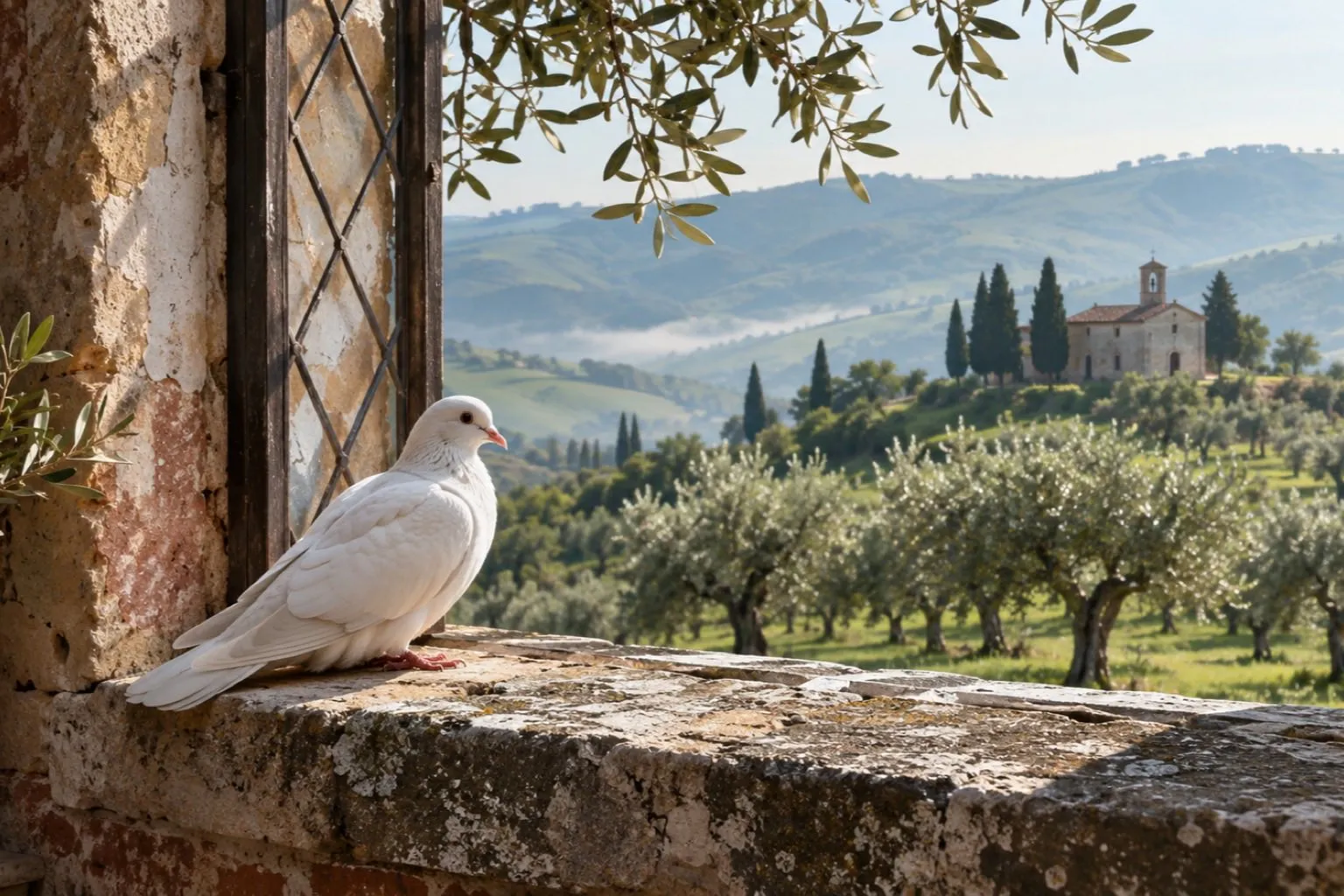
The prayer of Saint Francis, also called the Peace Prayer, is the short prayer that begins "Lord, make me an instrument of your peace." It asks God to make us people who bring love, forgiveness, faith, hope, light and joy wherever they are missing. Despite its name, it was not written by Francis of Assisi. It first appeared in a French Catholic magazine in 1912 and was linked to Francis only later.
Below is the full text, the true story of where it came from, what each line means in the light of Scripture, and a few new prayers written in the same spirit.
The Prayer of Saint Francis: full text
This is the English wording printed in the Quaker magazine Friends' Intelligencer in January 1927, the earliest known English version. It is in the public domain.
Lord, make me an instrument of your peace; where there is hatred, let me sow love; where there is injury, pardon; where there is discord, union; where there is doubt, faith; where there is despair, hope; where there is darkness, light; and where there is sadness, joy.
O Divine Master, grant that I may not so much seek to be consoled, as to console; to be understood, as to understand; to be loved, as to love; for it is in giving that we receive, it is in pardoning that we are pardoned, and it is in dying that we are born to eternal life. Amen.
Many prayer books leave out the line about discord and union, and some older versions use "thy" in place of "your." The heart of the prayer is the same in every version.
Who wrote the Prayer of Saint Francis?
Nobody knows for certain, but historians agree it was not Francis of Assisi, who died in 1226. The prayer does not appear in any of his writings or in any source from the Middle Ages. Its known history begins about seven centuries after his death:
- 1912, France. The prayer appeared without an author's name in the December 1912 issue of La Clochette ("The Little Bell"), a small devotional magazine of a Catholic group called the League of the Holy Mass. It was titled "A beautiful prayer to say during Mass." Historian Christian Renoux, who traced its history, concluded that the magazine's founding editor, Father Esther Bouquerel, most likely wrote it. That is a strong possibility, not a proven fact.
- 1915 to 1916, the Vatican. During the First World War, a French nobleman, the Marquis Stanislas de La Rochethulon, sent the prayer to Pope Benedict XV. An Italian translation ran on the front page of the Vatican newspaper L'Osservatore Romano on 20 January 1916, presented as a prayer for peace. French Catholic newspapers soon reprinted it.
- Around the end of the war. A French Franciscan priest, Father Étienne Benoît, printed the text as a "Prayer for Peace" on the back of a holy card. The front showed a picture of Saint Francis. The card did not claim Francis wrote it, but readers naturally connected the two.
- The 1920s. The prayer began to circulate under Francis's name. Its first known English version appeared in the United States in Friends' Intelligencer on 22 January 1927, titled as a prayer of Saint Francis of Assisi.
- Later. During the Second World War, Archbishop Francis Spellman of New York distributed millions of copies. Mother Teresa made it part of the daily prayers of her Missionaries of Charity and asked for it to be recited when she received the Nobel Peace Prize in 1979.
Why is it still called the prayer of Saint Francis?
Because the name stuck, and because it fits. Francis was known for greeting people with a wish for peace, for loving the poor and for choosing to give rather than to get. The prayer reads like a summary of the way he tried to follow Jesus. It is a little like the Apostles' Creed, which was not written by the twelve apostles either but faithfully states what they taught.
What does "make me an instrument of your peace" mean?
An instrument is a tool in someone else's hand. The opening line does not ask God to make us peaceful people who keep quiet and avoid trouble. It asks him to use us to bring his peace to others. Jesus said that people who do this share his Father's family likeness.
Matthew 5:9 — "Blessed are the peacemakers, for they shall be called children of God."
The peace in view is God's peace, not just the absence of conflict. Jesus gave it to his disciples the night before he died, and it is a gift before it is a task.
John 14:27 — "Peace I leave with you. My peace I give to you; not as the world gives, give I to you. Don’t let your heart be troubled, neither let it be fearful."
We cannot pass on what we have not received, which is why the prayer starts with "Lord."
What does each line of the prayer mean?
Where there is hatred, let me sow love
Sowing is slow work. You plant and wait. This line asks for patience to keep loving people who are hostile, the way Jesus told us to love our enemies and pray for those who persecute us (Matthew 5:44). Paul gives the same instruction in one short sentence.
Romans 12:21 — "Don’t be overcome by evil, but overcome evil with good."
Where there is injury, pardon
Pardon means forgiveness. When someone wounds us, the natural response is to wound back or to withdraw. The prayer asks for the harder way: to forgive as the Lord has forgiven us (Colossians 3:13).
Where there is discord, union
This line asks God to make us bridge builders in families, churches and workplaces, people who work to keep the unity of the Spirit in the bond of peace (Ephesians 4:3).
Where there is doubt, faith; where there is despair, hope
We cannot create faith or hope in anyone, but we can point to the God who gives them, often simply by staying with someone in a dark season.
Where there is darkness, light; where there is sadness, joy
Jesus called his followers the light of the world (Matthew 5:14). A Christian can carry light into a hospital room, a grieving home or a tense meeting, not by forced cheerfulness but by bringing the presence of Christ.
To console, to understand, to love
The second half turns from what we do to what we want. It asks God to free us from needing comfort, understanding and love first, so that we can give them first. Paul says God comforts us in our troubles so that we can comfort others with the comfort we have received (2 Corinthians 1:3-4).
It is in giving that we receive
This echoes the words of Jesus that Paul quoted: it is more blessed to give than to receive (Acts 20:35). The giver does not lose.
It is in pardoning that we are pardoned
Jesus links our forgiveness of others with our own forgiveness in the Lord's Prayer and the verses after it (Matthew 6:12-15). This does not mean we earn God's forgiveness by forgiving. It means people who have truly received mercy become merciful.
It is in dying that we are born to eternal life
The final line has two senses. It speaks of dying to self every day, and it looks ahead to physical death as the doorway to life with God. Paul describes the first sense this way.
Galatians 2:20 — "I have been crucified with Christ, and it is no longer I that live, but Christ living in me. That life which I now live in the flesh, I live by faith in the Son of God, who loved me, and gave himself up for me."
A gentle note for readers: the prayer does not explain how a person receives eternal life. Scripture is clear that eternal life is God's gift through faith in Jesus, not a reward for self-giving (Ephesians 2:8-9). The self-giving the prayer describes is the fruit of that new life, not its price.
How to pray the prayer of Saint Francis today
- Pray it slowly. Read one line, then stop and ask where it applies today.
- Put names to it. Where is there hatred, injury or discord in your life? Pray the line with a person in mind.
- Take one line a day. Over two weeks you can pray through the whole prayer, one phrase each morning.
- Use it at the end of the day. Look back and ask where you sowed love or failed to, then confess and receive God's forgiveness.
For more prayers on this theme, see our collection of prayers for peace.
"Make Me a Channel of Your Peace": the hymn
Many people know the prayer through the song "Make Me a Channel of Your Peace." It was written in 1967 by Sebastian Temple, a South African-born songwriter who moved to the United States, became a Catholic and joined the Secular Franciscan Order. He set a lightly reworded version of the prayer to a simple melody, and it now appears in hymnals across many denominations, Catholic and Protestant alike.
Prayers in the spirit of Saint Francis
These are new prayers, written to carry the same desire into everyday situations.
A prayer to be a peacemaker at home
Lord Jesus, you are the Prince of Peace, and my home needs your peace today. Where there are sharp words, help me answer gently. Where there is hurt, help me be the first to say sorry and the first to forgive. Make our home a place where people feel safe and loved. In Jesus' name, Amen.
A prayer to forgive someone who hurt me
Heavenly Father, you know how deeply I was hurt and how much I want to hold on to it. You have forgiven me far more than I will ever need to forgive. Give me the grace to release this person into your hands and to stop replaying the wound. Heal what is broken in me as I choose to forgive. In Jesus' name, Amen.
A prayer to give rather than receive
Father, I confess that I often want to be comforted, understood and loved before I offer those things to anyone else. Turn my attention outward today. Show me one person who needs encouragement, and give me the courage to go to them. Let me find, as Jesus said, that giving is the greater blessing. In Jesus' name, Amen.
A prayer for peace in a divided world
Lord, the news is full of anger, and I feel it rising in my own heart. Guard me from hatred toward people who think differently from me. Make me an instrument of your peace in conversations, online and in my community. Comfort those who suffer because of war and violence, and bring your justice and peace. In Jesus' name, Amen.
FAQ
Did Saint Francis write the Prayer of Saint Francis?
No. The prayer first appeared anonymously in a French magazine, La Clochette, in 1912, almost 700 years after Francis died. It was linked with him after a Franciscan priest printed it on the back of a holy card showing Francis, and by the 1920s it carried his name.
Who actually wrote the prayer?
The author is unknown. Historian Christian Renoux concluded that the most likely writer was Father Esther Bouquerel, the founder and editor of La Clochette, but this has not been proven.
Is the Prayer of Saint Francis in the Bible?
No, but almost every line echoes Scripture. It reflects Matthew 5:9 on peacemakers, Romans 12:21 on overcoming evil with good, Acts 20:35 on giving and Galatians 2:20 on dying to self.
Can Protestants pray the Prayer of Saint Francis?
Yes. Although it began in a Catholic setting, its first English publication was in a Quaker magazine, and Christians of many traditions pray and sing it. It contains no teaching that evangelical Protestants would find objectionable, and it is addressed to the Lord.
Who wrote "Make Me a Channel of Your Peace"?
Sebastian Temple wrote the hymn in 1967, adapting the words of the prayer and composing the tune. He was a South African-born musician and a member of the Secular Franciscan Order.
When is the Prayer of Saint Francis used?
It is often prayed in personal devotions, at weddings and funerals, in services for peace and at meetings where people seek reconciliation. Many churches also pray or sing it on the Feast of Saint Francis, October 4.