Should Pastors Endorse Political Candidates? What the Law and the Bible Say
US law has barred churches from endorsing candidates since 1954, and the rule is now being fought over in court. Here is where the law stands, what pastors think, and what Scripture says.
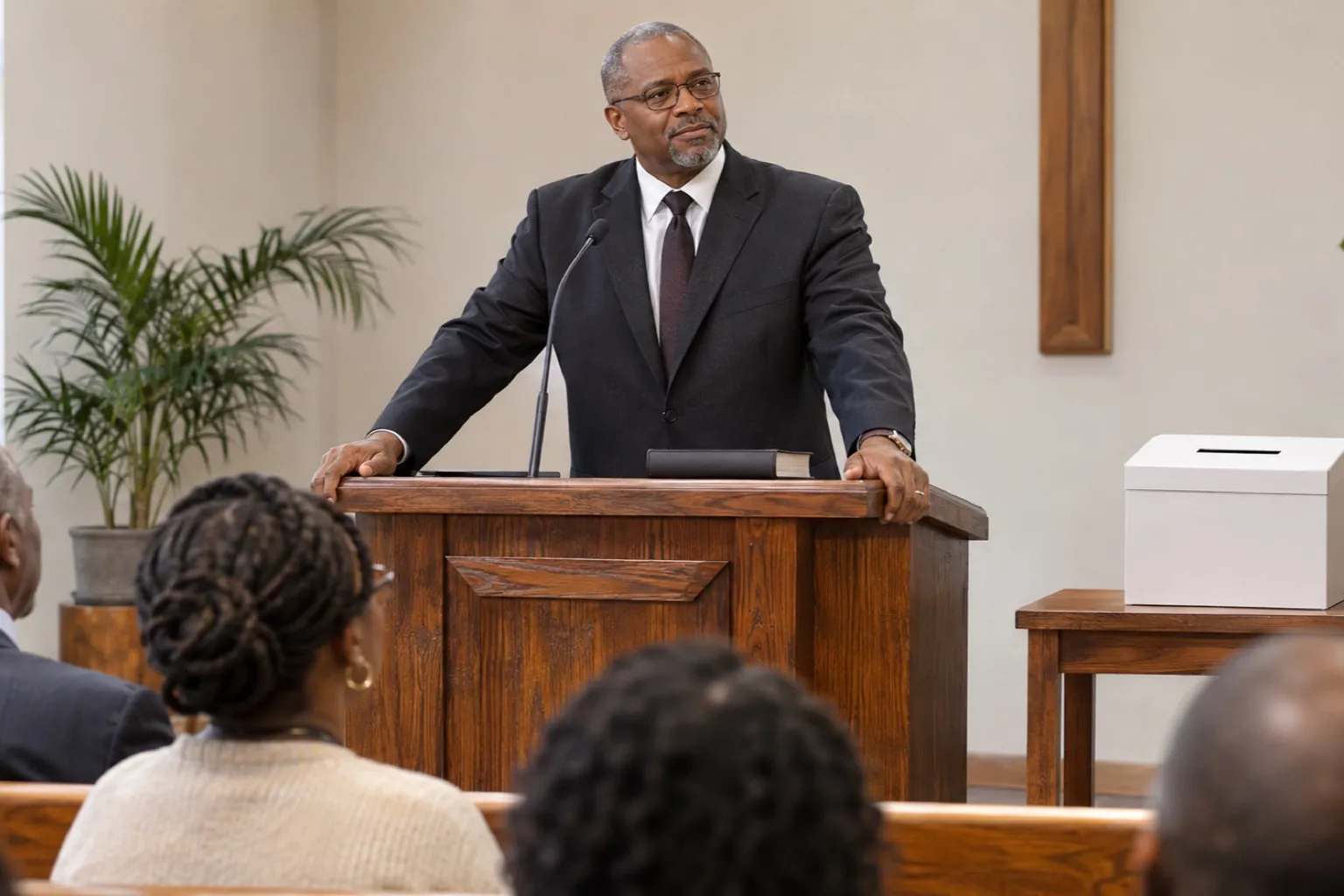
Every election season, the same question lands on the desks of church leaders: should pastors endorse political candidates? It is partly a legal question and partly a pastoral one, and the two get mixed up. In this guide we separate them. We look first at what the law says today, then at what pastors and churchgoers actually think, and then at what Scripture teaches about the pulpit and politics.
The Short Answer
In the United States, a church that wants to keep its tax-exempt status may not endorse or oppose a candidate for public office. That rule, known as the Johnson Amendment, is still the law as of November 2026, although it is being challenged in federal court. A pastor may endorse a candidate as a private citizen. Whether a pastor should is a different matter. The great majority of Protestant pastors say they will not do it from the pulpit, and we think the Bible gives good reasons for that restraint.
Should Pastors Endorse Political Candidates Under US Law?
The rule dates from 1954. Senator Lyndon B. Johnson offered it as a floor amendment to the tax code, and it passed without hearings. It says that organizations exempt from tax under section 501(c)(3), which includes churches, may not take part in any political campaign on behalf of, or in opposition to, any candidate for public office.
The Internal Revenue Service spells out what that means for churches in its tax guide for churches and religious organizations. In plain terms:
- Not allowed: a statement for or against a candidate in a sermon, a church bulletin, the church website or at an official church event, and the use of church money for a campaign.
- Allowed: preaching on moral and social issues, nonpartisan voter registration, and voter guides that treat all candidates even-handedly.
- Allowed as an individual: a pastor may endorse a candidate personally, so long as it is not done in an official church publication or at an official church function, and it is clear the pastor is not speaking for the church.
The penalty on paper is loss of tax-exempt status and an excise tax. In practice it has almost never been used against a church. The one clear case is the Church at Pierce Creek in Binghamton, New York. On October 30, 1992, it ran full-page newspaper advertisements urging Christians not to vote for Bill Clinton. The IRS revoked its exemption in 1995, and a federal appeals court upheld that decision in 2000.
Where the Court Case Stands Now
The rule has been contested for years. Since 2008, some pastors have taken part in "Pulpit Freedom Sunday," deliberately preaching about candidates in the hope of a test case. In 2017 an executive order told the Treasury not to penalize houses of worship for speaking on moral or political issues from a religious perspective.
The biggest change came in July 2025. In a lawsuit brought by the National Religious Broadcasters and two Texas churches, the IRS told the court that when a house of worship speaks to its own congregation, in connection with a religious service and through its usual channels, about electoral politics seen through the lens of faith, it is not taking part in a campaign. Many headlines reported this as the end of the Johnson Amendment.
It was not. On March 31, 2026, the district judge dismissed the case without approving the agreement, so it never took effect. The churches appealed to the Fifth Circuit, and in September 2026 the Department of Justice filed in support of them. As of November 2026, the appeals court had not ruled, and the IRS had not issued new guidance. Until one of those things happens, the old rule applies. If your church is weighing this, ask a lawyer who knows nonprofit law, because the ground may shift.
What Pastors and Churchgoers Think
The legal fight can give the impression that pastors are straining to endorse. They are not. Lifeway Research asked about a thousand Protestant pastors in September 2025 whether they planned to endorse candidates during a worship service, now that the IRS had said it would allow it. Five percent said yes. Ninety-three percent said no.
People in the pews mostly agree. A Lifeway survey of American adults in 2024 found that 29 percent thought it appropriate for a pastor to endorse a candidate during a service, and 60 percent did not. A Pew Research Center survey in 2022 found that 77 percent of Americans said churches should not endorse candidates.
The well-known pastor Rick Warren put the common view into one sentence in 2008, when he hosted both presidential candidates at his church and endorsed neither: "We believe in the separation of church and state, but we do not believe in the separation of faith and politics."
What the Bible Says About the Pulpit and Politics
Scripture does not mention elections, but it has a good deal to say about how God's people relate to those who govern.
We are told to pray for rulers, whoever they are.
1 Timothy 2:1-2 — "I exhort therefore, first of all, that petitions, prayers, intercessions, and givings of thanks, be made for all men: for kings and all who are in high places; that we may lead a tranquil and quiet life in all godliness and reverence."
Paul wrote that under a Roman emperor no Christian had chosen. The command does not depend on whether we voted for the person in office.
We are told that our first citizenship is elsewhere.
Philippians 3:20 — "For our citizenship is in heaven, from where we also wait for a Savior, the Lord Jesus Christ."
Jesus said the same before Pilate.
John 18:36 — "Jesus answered, “My Kingdom is not of this world. If my Kingdom were of this world, then my servants would fight, that I wouldn’t be delivered to the Jews. But now my Kingdom is not from here.”"
A church that ties itself to a party risks telling its neighbors that the kingdom of God has a campaign office.
We are told to give the state its due, and no more.
Matthew 22:21 — "They said to him, “Caesar’s.” Then he said to them, “Give therefore to Caesar the things that are Caesar’s, and to God the things that are God’s.”"
And we are told to speak up for what is right. Silence is not the biblical position either. The prophets confronted kings, and the apostles refused an order to stop preaching.
Proverbs 31:8-9 — "Open your mouth for the mute, in the cause of all who are left desolate. Open your mouth, judge righteously, and serve justice to the poor and needy."
Acts 5:29 — "But Peter and the apostles answered, We must obey God rather than men."
Put together, these passages point in one direction. The preacher's task is to preach the word, including what it says about justice, life, honesty, the poor and the stranger, and to let the congregation carry that into the voting booth.
2 Timothy 4:2 — "preach the word; be urgent in season and out of season; reprove, rebuke, and exhort, with all patience and teaching."
The Case For and Against Endorsing
Sincere Christians land in different places, so we want to state both sides fairly.
Those who would endorse argue that a pastor does not lose the right of free speech by entering a pulpit, that the government has no business policing sermons, and that some elections carry moral stakes so high that naming a candidate is simply honest shepherding. Many Black churches, they note, have a long tradition of welcoming candidates to speak.
Those who would not argue that an endorsement divides a congregation that Christ has united, that it lends the church's name to everything a candidate later says and does, and that it makes it harder to speak truth to that candidate once in office. They also point out that most church members do not want it.
We find the second case stronger. A pastor is called to shepherd people who vote in different ways, and a pulpit endorsement tells some of them they are no longer quite at home. Our guide to navigating church politics looks at how division of other kinds takes root in a congregation.
A Practical Path for Church Leaders
- Preach the issues, not the names. Teach what Scripture says and trust your people to apply it.
- Pray publicly for all who hold office and all who seek it, by name if you wish, without favor.
- Encourage voting and offer nonpartisan help with registration.
- Keep personal views personal. If you endorse as a citizen, do it away from church platforms and say plainly that you speak for yourself.
- Agree a policy with your leadership before the season begins, so no one is caught off guard. The character Scripture asks of leaders, set out in our guide to the qualifications of an elder, includes being gentle and not quarrelsome.
Titus 3:1-2 — "Remind them to be in subjection to rulers and to authorities, to be obedient, to be ready for every good work, to speak evil of no one, not to be contentious, to be gentle, showing all humility toward all men."
Conclusion
Should pastors endorse political candidates? The law, for now, says a church may not, and a court may yet change that. But the deeper answer does not depend on the tax code. A pastor's authority comes from the word of God, and it is spent best on what that word says. Preach it fully, pray for those who govern, speak up for those who cannot speak for themselves, and leave the ballot to the conscience of each believer.