A.E. Wilder-Smith: From Atheist to Champion of Faith
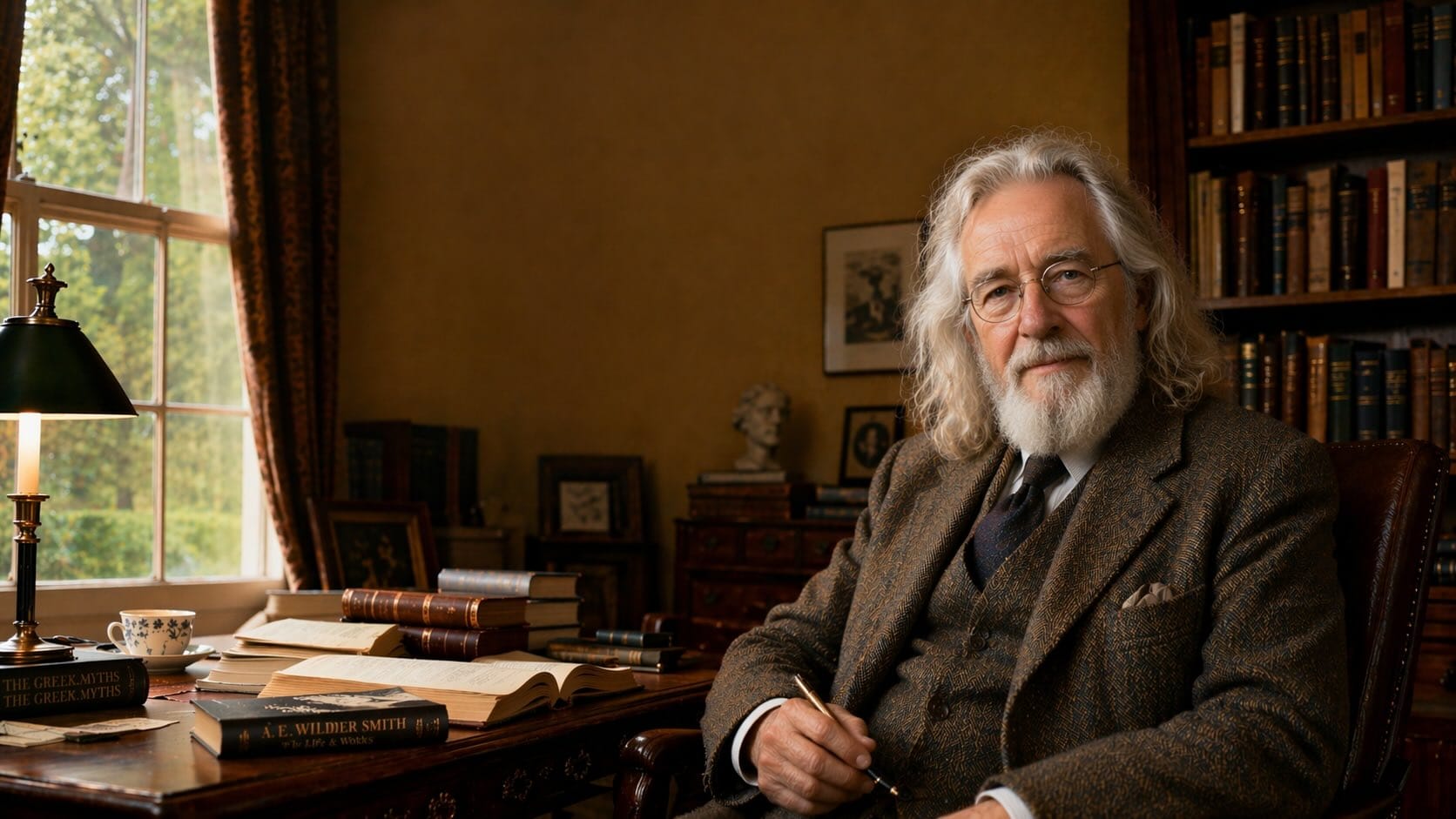
A.E. Wilder-Smith: The Atheist Who Found God
Some of the most powerful testimonies come from those who once stood firmly against faith.
Arthur Ernest Wilder-Smith was born in Reading, England, on 22 December 1915. Raised in an agnostic household, he concluded early in life that God could not exist. In his own words, 'If a loving God really existed, He surely would not have tolerated all the injustice and suffering evident in the world.'
It was a reasonable objection. Many have asked the same question. Yet this brilliant young scientist, who would go on to earn three doctorates and teach at universities across the world, would one day become one of Christianity's most compelling voices.
His journey from atheism to faith is a reminder that God often pursues the very people who are running hardest in the opposite direction.
The Encounter That Changed Everything
While studying at Oxford, Wilder-Smith met a man known simply as General Frost, a devout Christian who was unafraid to challenge his atheistic worldview.
The General did not argue. He did not condemn. He simply asked questions that Arthur could not answer, and offered a perspective that Arthur had never seriously considered.
Something stirred in the young scientist's heart.
Shortly after, Wilder-Smith encountered another influence that would shape his thinking for the rest of his life: C.S. Lewis. The two men met at Oxford, and Lewis's approach to faith, both intellectually rigorous and deeply personal, gave Arthur a framework for belief that he had never thought possible.
He placed his faith in Christ. But the journey was only beginning.
A Mind Transformed
Becoming a Christian did not mean abandoning his intellect. For Wilder-Smith, it meant using it more fully than ever before.
He earned his first PhD in Physical Organic Chemistry from the University of Reading in 1941. He later completed a second doctorate in Pharmacology from the University of Geneva, and a third in Pharmacological Sciences from the Swiss Federal Institute of Technology in Zurich.
Throughout his career, he held professorships at the University of Illinois, the University of Geneva, the University of Bergen in Norway, and Hacettepe University in Turkey. He won three consecutive 'Golden Apple' awards for excellence in teaching. He served as a NATO consultant. He authored over 70 scientific publications and more than 30 books, translated into 17 languages.
By any measure, A.E. Wilder-Smith was a giant in his field.
Yet he never forgot where his wisdom truly came from.
'The fear of the Lord is the beginning of knowledge, but fools despise wisdom and instruction.' (Proverbs 1:7)
Faith and Science: Not Enemies, But Allies
Wilder-Smith spent much of his later career demonstrating that faith and science were not in conflict. He argued, calmly and persuasively, that the evidence pointed toward a Creator rather than away from one.
In 1986, he was invited to deliver the prestigious Huxley Memorial Lecture at the University of Oxford. That same year, he participated in a formal debate at the Oxford Union alongside physicist Edgar Andrews, facing off against Richard Dawkins and John Maynard Smith.
He did not shy away from difficult conversations. He did not retreat from hostile audiences. He simply presented the truth as he understood it, trusting that God's Word could stand on its own.
His book The Creation of Life became a foundational text for many who sought to reconcile scientific inquiry with biblical faith. Another work, Man's Origin, Man's Destiny, explored the deeper questions of human purpose and eternal significance.
William Dembski, a leading figure in the Intelligent Design movement, credits Wilder-Smith as a primary inspiration. Dean Kenyon, a former evolutionary researcher, called him 'one of the two or three most important scientists in my life.'
The seeds he planted continue to bear fruit today.
A Life of Faithfulness
Beyond his academic achievements, Wilder-Smith was a devoted husband and father.
In 1949, he married Beate Gottwaldt, daughter of a German pastor. Together, they moved home 23 times as his career took them across continents. They raised four children, Oliver, Petra, Clive, and Einar, each of whom went on to become professors in their own right.
His wife later wrote a memoir of their life together, Fulfilled Journey: The Wilder-Smith Memoirs, documenting the remarkable path God had led them on.
Arthur Ernest Wilder-Smith passed away on 14 September 1995. He was 79 years old.
He left behind a legacy that continues to inspire Christians around the world. At Higher Praise, we remember him not only for his intellect, but for his courage, his faithfulness, and his willingness to follow Christ wherever that journey led.
Where to Find His Teachings Today
Dr. Wilder-Smith's lectures and sermons remain available through various Christian archives. His film series, ORIGINS: How the World Came to Be, was broadcast across North America, Australia, South Africa, Russia, and the former Soviet Union.
For those wishing to explore his work further, Higher Praise recommends:
- SermonIndex.net – A collection of his audio sermons and lectures
- Creation.com – Biographical information and tributes
- The Word for Today – Publishers of Fulfilled Journey: The Wilder-Smith Memoirs
His books, including The Creation of Life, Man's Origin, Man's Destiny, and The Natural Sciences Know Nothing of Evolution, can be found through Christian bookshops and online retailers.
What Can We Learn From His Life?
A.E. Wilder-Smith's story teaches us several things.
First, no one is beyond the reach of God. Arthur began as an atheist, convinced that faith was intellectually beneath him. Yet God pursued him, used faithful witnesses like General Frost and C.S. Lewis, and transformed him into one of Christianity's greatest defenders.
Second, faith does not require us to abandon our minds. Wilder-Smith earned three doctorates. He taught at world-renowned universities. He published in peer-reviewed journals. And he believed, with full conviction, that the Bible was true.
Third, faithfulness matters more than fame. Wilder-Smith never sought celebrity. He simply followed where God led, taught what he believed to be true, and trusted the results to his Creator.
At Higher Praise, we believe these lessons are as relevant today as they were in his lifetime.
'Trust in the Lord with all your heart and lean not on your own understanding; in all your ways submit to him, and he will make your paths straight.' (Proverbs 3:5-6)
Frequently Asked Questions
Who was A.E. Wilder-Smith? Arthur Ernest Wilder-Smith (1915–1995) was a British organic chemist who held three doctorates and became a prominent Christian apologist and creation scientist. He authored over 30 books and was known for defending biblical faith from a scientific perspective.
Was A.E. Wilder-Smith always a Christian? No. Wilder-Smith began as an atheist. He converted to Christianity in his early twenties after encountering General Frost and being influenced by C.S. Lewis while studying at Oxford.
What is A.E. Wilder-Smith best known for? He is best known for his books on science and faith, his 1986 debate with Richard Dawkins at the Oxford Union, and his film series ORIGINS: How the World Came to Be.
Where can I listen to A.E. Wilder-Smith's sermons? His sermons and lectures are available on SermonIndex.net and through various Christian media archives. Higher Praise also recommends exploring Creation.com for further resources.
What books did A.E. Wilder-Smith write? His most notable books include The Creation of Life, Man's Origin, Man's Destiny, The Natural Sciences Know Nothing of Evolution, and his memoir co-authored with his wife, Fulfilled Journey.