
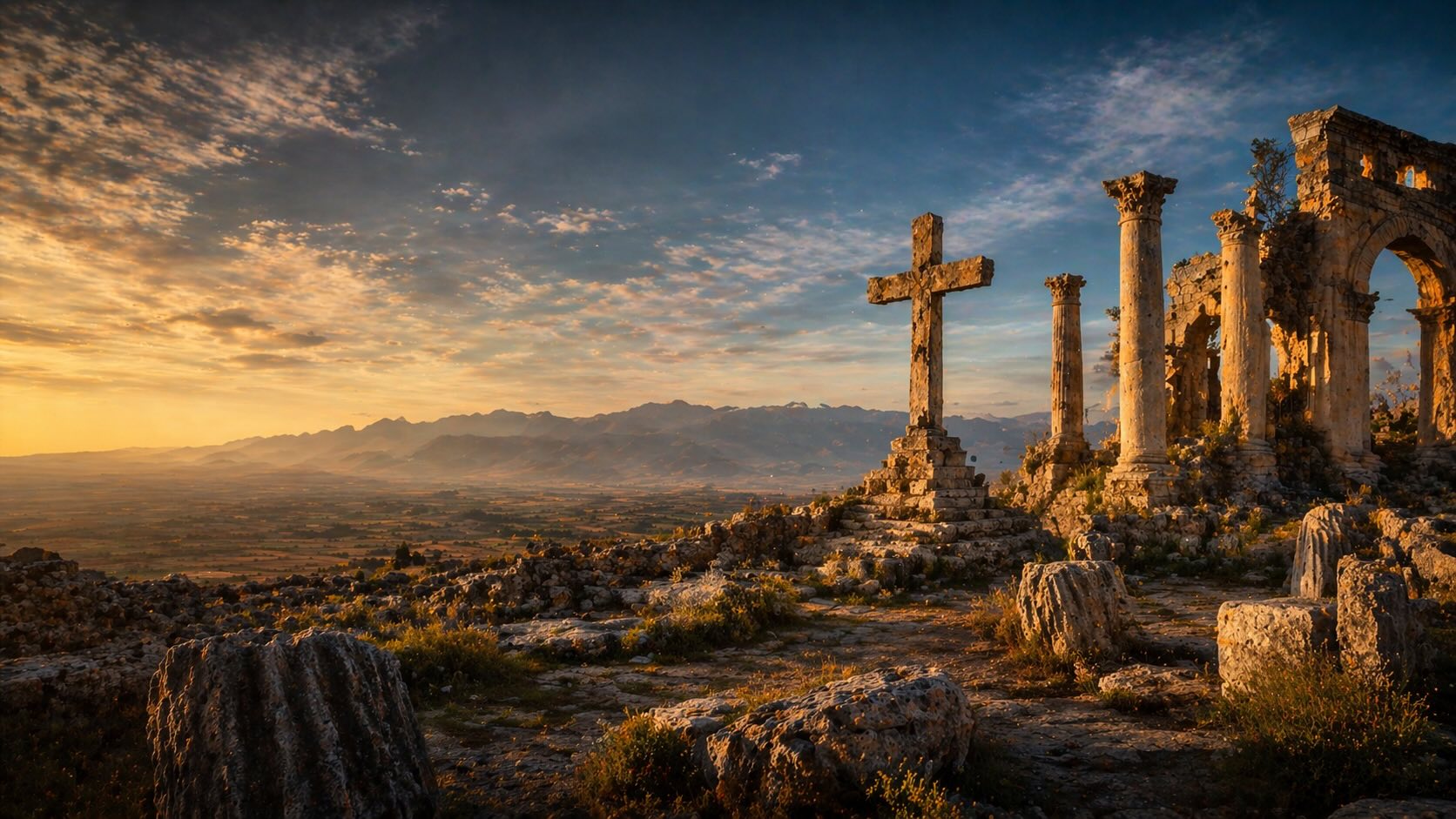

When Pope Leo XIV visited Algeria in April 2026, he walked through the ruins of ancient Hippo — now called Annaba — where Saint Augustine once served as bishop. The pope called Algeria “the land of my spiritual father” and celebrated Mass in the Basilica of Saint Augustine, built on the hillside where the great theologian died in 430 AD.
For most Western Christians, this connection comes as a surprise. We think of Augustine as European, his works studied in seminaries from Oxford to Rome. We forget that he never set foot in Western Europe except for a brief period in Milan. Augustine was African. So were Tertullian, Cyprian, and at least three popes. North Africa was not a peripheral outpost of early Christianity; it was the heartland.
Today, Algeria is 99 percent Muslim. Fewer than 10,000 Catholics remain among 48 million people. Churches have been shuttered. Believers worship in secret. How did the cradle of Latin Christianity become one of the most difficult places on earth to follow Jesus?
At Higher Praise, we believe this history matters — not as an academic curiosity, but as a sobering lesson for the church today.
The Golden Age of African Christianity
Christianity arrived in North Africa within decades of the resurrection. By 180 AD, the faith had taken firm root in Carthage (modern Tunisia) and spread westward into what is now Algeria. According to the Roman historian Theodor Mommsen, the Mediterranean coast of Algeria was “fully Christian by the fifth century.”
This was no marginal movement. North Africa produced some of the most influential theologians in Christian history.
Tertullian (c. 155–220 AD), born in Carthage, is called “the father of Latin Christianity.” He was the first major Christian writer to compose his works in Latin rather than Greek, creating a theological vocabulary that shaped Western thought for centuries. Tertullian coined the term “Trinity” (Latin: trinitas) to describe the Godhead and developed language about the relationship between Father, Son, and Holy Spirit that would influence the Council of Nicaea over a century later.
Cyprian (c. 200–258 AD), bishop of Carthage, was a wealthy aristocrat who converted to Christianity and gave away his fortune. He led the North African church through the Decian persecution, wrote extensively on church unity, and was eventually martyred under Emperor Valerian. Cyprian’s writings on the episcopate and sacraments shaped Catholic ecclesiology for centuries.
Augustine (354–430 AD), born in Thagaste (modern Souk Ahras, Algeria), towers above them all. His mother Monica — also North African — is venerated as a saint in her own right. Augustine’s restless youth, brilliantly narrated in his Confessions, led him through Manichaeism and Neoplatonism before his dramatic conversion in Milan. He returned to Africa, was ordained in Hippo against his will, and served as bishop for over 30 years.
Augustine’s theological output was staggering. His City of God, written after the sack of Rome in 410 AD, defined the relationship between church and state for a millennium. His writings on grace, original sin, and predestination became foundational for both Catholic and Protestant theology. Luther, Calvin, and the Reformers considered themselves Augustine’s heirs.
By the year 225 AD, approximately 70 bishops served in the Roman provinces of Africa. The region produced at least three popes of African descent: Victor I (189–199 AD), Miltiades (311–314 AD), and Gelasius I (492–496 AD). North Africa was not receiving Christianity from Europe; it was shaping the faith that Europe would inherit.
The Collapse
How did this flourishing church disappear?
The decline began before the Arab conquest. The Vandals — Germanic tribes professing Arian Christianity — swept across North Africa in the 430s, arriving at Hippo just as Augustine lay dying. For nearly a century, Vandal kings persecuted the orthodox Catholic population, exiling bishops and confiscating churches. The Byzantine reconquest in 534 AD restored orthodox Christianity, but the church never fully recovered its former vitality.
Then came the Arab armies.
The Umayyad Caliphate conquered North Africa between 647 and 709 AD. Unlike the Vandals, the Muslim conquerors did not initially force conversion. Christians and Jews were designated dhimmis — protected people who could practice their faith while paying special taxes and accepting second-class status. Many Christians, particularly among the Berber population, converted willingly. Others assimilated over generations.
Scholars debate why North African Christianity proved so fragile. Some point to the lack of a strong monastic tradition that might have preserved the faith through cultural upheaval. Others note that the Donatist controversy — a bitter schism that divided African Christians for centuries — had weakened the church’s unity and witness. The tribal structure of Berber society may have accelerated conversion, as entire clans shifted allegiance together.
Whatever the causes, the decline was steady. A Christian community survived in Kairouan (a city founded by Arabs in 670 AD) as late as 1150 AD. Bishoprics continued in scattered locations. But by the 11th century, the indigenous Christian population in Algeria had effectively vanished. A 14th-century letter in Catholic archives mentions only four bishoprics remaining in all of North Africa — down from over 400 at the time of the conquest.
For eight centuries, Christianity existed in Algeria only through European captives, merchants, and mercenaries in coastal trading posts.
The French Era
Christianity returned to Algeria in force with the French conquest of 1830. The Diocese of Algiers was established in 1838, and churches, schools, and hospitals followed. By the 1960 census, over one million non-Muslim civilians lived in Algeria — approximately 10 percent of the population — the vast majority of them Catholic.
However, this Christianity was largely imported. French colonial policy used Catholicism as a tool of cultural assimilation, creating resentment among the Muslim majority. The Crémieux Decree of 1870 granted full citizenship to Algerian Jews and Christians while denying it to Muslims, embedding religious identity into the structure of colonial oppression.
Algeria’s brutal war of independence (1954–1962) pitted the National Liberation Front against French forces in a conflict that claimed hundreds of thousands of lives. When Algeria gained independence in 1962, approximately 800,000 Pieds-Noirs — French settlers and their descendants — fled to France. The million-strong Catholic population collapsed almost overnight.
The Remnant Church
The Christians who remained after independence were mostly clergy, religious sisters, and a small number of Algerians who had converted or married Europeans. They faced a transformed landscape. The 1996 constitution declared Islam the state religion. Proselytising Muslims became illegal. The tiny Christian community turned inward, focused on charitable work rather than evangelism.
Then came the “Black Decade.”
From 1991 to 2002, Algeria descended into civil war between the government and Islamist insurgent groups. Between 100,000 and 200,000 Algerians died in the violence. Christians were not spared.
In March 1996, seven Trappist monks from the monastery of Tibhirine were kidnapped by armed men. Two months later, their severed heads were found; their bodies were never recovered. The monks had refused to leave despite the danger, choosing to remain with their Muslim neighbours whom they loved and served. They were beatified by Pope Francis in 2018.
Three months after Tibhirine, Pierre Claverie, the Bishop of Oran, was assassinated by a bomb planted at his residence. He had been an outspoken advocate for dialogue and peace. In total, 19 Catholic priests and religious were killed during the Black Decade, officially recognised as martyrs by the Vatican.
Algeria Today
The violence eventually subsided, but restrictions on Christianity have tightened. Algeria ranks number 20 on the 2026 World Watch List of countries where Christians face the most persecution. Open Doors notes that believers have been “driven underground by surveillance and crippling regulations.”
Courts have imprisoned Christians for “unauthorised worship” and “offence to Islam.” Churches have been forcibly closed. Converts from Islam face intense pressure from family and community, and the government views their conversion with suspicion. Some clergy report that applications for baptism are scrutinised by security services, creating fear of infiltration.
Yet Christianity persists.
Estimates suggest between 50,000 and 100,000 Protestants now live in Algeria, most of them Berber converts concentrated in the Kabylie region. This represents a remarkable shift. For the first time since the medieval era, a genuinely Algerian church — not imported from Europe — is growing. These believers worship in homes and small gatherings, often at significant personal cost.
Pope Leo XIV’s visit brought global attention to this remnant community. At the Basilica of Our Lady of Africa in Algiers, he encouraged the faithful: “Bear witness to the Gospel through simple gestures, genuine relationships and a dialogue lived out day by day.” Behind the basilica’s statue of the Black Virgin Mary — venerated by both Christians and Muslims — are inscribed the words: “Pray for us and for the Muslims.”
Lessons for Today
What should Western Christians learn from Algeria’s history?
First, we must not take the church’s permanence for granted. North African Christianity flourished for over 600 years before its gradual extinction. Institutions that seem unshakeable can crumble within generations. The faith must be transmitted anew to each generation through personal witness, strong families, and vibrant communities — not merely inherited through cultural inertia.
Second, internal division weakens the church’s witness. The Donatist controversy consumed African Christianity’s energy for centuries, leaving it fractured when external pressure arrived. Theological precision matters, but so does unity. Jesus prayed that His followers would be one “so that the world may believe” (John 17:21).
Third, Christianity tied too closely to political power becomes vulnerable when that power shifts. French colonial Christianity, whatever its merits, was perceived by many Algerians as an instrument of oppression. When colonial rule ended, so did colonial religion. The gospel must be clearly distinguished from any particular political or cultural project.
Fourth, faithfulness sometimes means staying. The monks of Tibhirine, the 19 martyrs of the Black Decade, and countless unknown believers chose presence over safety. Their witness speaks across centuries to a church tempted by comfort and self-preservation. As Bishop Claverie wrote before his death: “The church accomplishes its vocation when it is present at the ruptures which crucify humanity.”
Finally, hope persists. The church in Algeria today is smaller than at any point since the Arab conquest — yet it is growing, and it is genuinely Algerian. What colonialism could not achieve, the Holy Spirit is accomplishing through quiet witness and costly faithfulness.
Conclusion
When Pope Leo XIV knelt in the ruins of Hippo, he was kneeling where Augustine had knelt sixteen centuries earlier. The buildings have crumbled. The congregations have scattered. The great theological schools have fallen silent.
But the God whom Augustine discovered in that garden in Milan — the God of grace, the God who pursues restless hearts until they find their rest in Him — that God has not abandoned North Africa. He never abandons His people.
The Higher Praise community prays for the church in Algeria: for courage, for protection, for growth. We remember our brothers and sisters who worship in secret, who face surveillance and suspicion, who love their neighbours while holding fast to Jesus.
And we ask ourselves: Would our faith survive what theirs has survived? Would we still be following Jesus if following Him cost everything?
Augustine’s most famous words remain as true today as when he wrote them in Carthage: “You have made us for yourself, O Lord, and our hearts are restless until they rest in you.”
May the restless hearts of Algeria find that rest. And may we in the comfortable West learn from their costly faithfulness before comfort makes us careless.
FAQ — People Also Ask
Was St. Augustine African? Yes. Augustine was born in 354 AD in Thagaste, a town in the Roman province of Numidia that is now Souk Ahras in northeastern Algeria. His mother Monica was also North African. Augustine spent most of his life in Africa, serving as bishop of Hippo (modern Annaba, Algeria) for over 30 years until his death in 430 AD.
Was North Africa ever Christian? Yes. Christianity arrived in North Africa in the first and second centuries AD. By the fifth century, the region was considered fully Christian. North Africa produced major theologians including Tertullian, Cyprian, and Augustine, and at least three popes of African descent. The faith declined after the Arab conquest (647–709 AD) and had largely disappeared by the 11th century.
Who were the North African church fathers? The most prominent were Tertullian (c. 155–220 AD), called “the father of Latin Christianity” and the first to use the term “Trinity”; Cyprian (c. 200–258 AD), bishop and martyr of Carthage; and Augustine (354–430 AD), bishop of Hippo and arguably the most influential theologian in Western Christianity.
When did Algeria become Muslim? The Arab conquest of North Africa occurred between 647 and 709 AD. However, Islamisation was gradual. Christian communities persisted for centuries, with the last indigenous Christian populations disappearing from Algeria around the 11th century. Today, approximately 99 percent of Algerians identify as Sunni Muslim.
Are there Christians in Algeria today? Yes, though they represent a tiny minority. Estimates suggest 50,000–100,000 Protestants (mostly Berber converts) and fewer than 50,000 Catholics among Algeria’s 48 million people. Christians face significant restrictions, and Algeria ranks number 20 on the 2026 World Watch List of countries where believers face persecution.
What happened to the monks of Tibhirine? In March 1996, seven Trappist monks from the Tibhirine monastery in Algeria were kidnapped by armed Islamists during the Algerian Civil War. Their severed heads were found two months later; the full circumstances of their deaths remain disputed. They were beatified in 2018 and are celebrated as martyrs. Their story was told in the film “Of Gods and Men” (2010).
Who was Pierre Claverie? Pierre Claverie was the Catholic Bishop of Oran, Algeria, assassinated by a bomb in August 1996 during the Algerian Civil War. He was an advocate for Christian-Muslim dialogue and refused to leave Algeria despite the danger. He was among 19 Catholic clergy killed during the “Black Decade” (1991–2002) and was beatified along with them in 2018.