
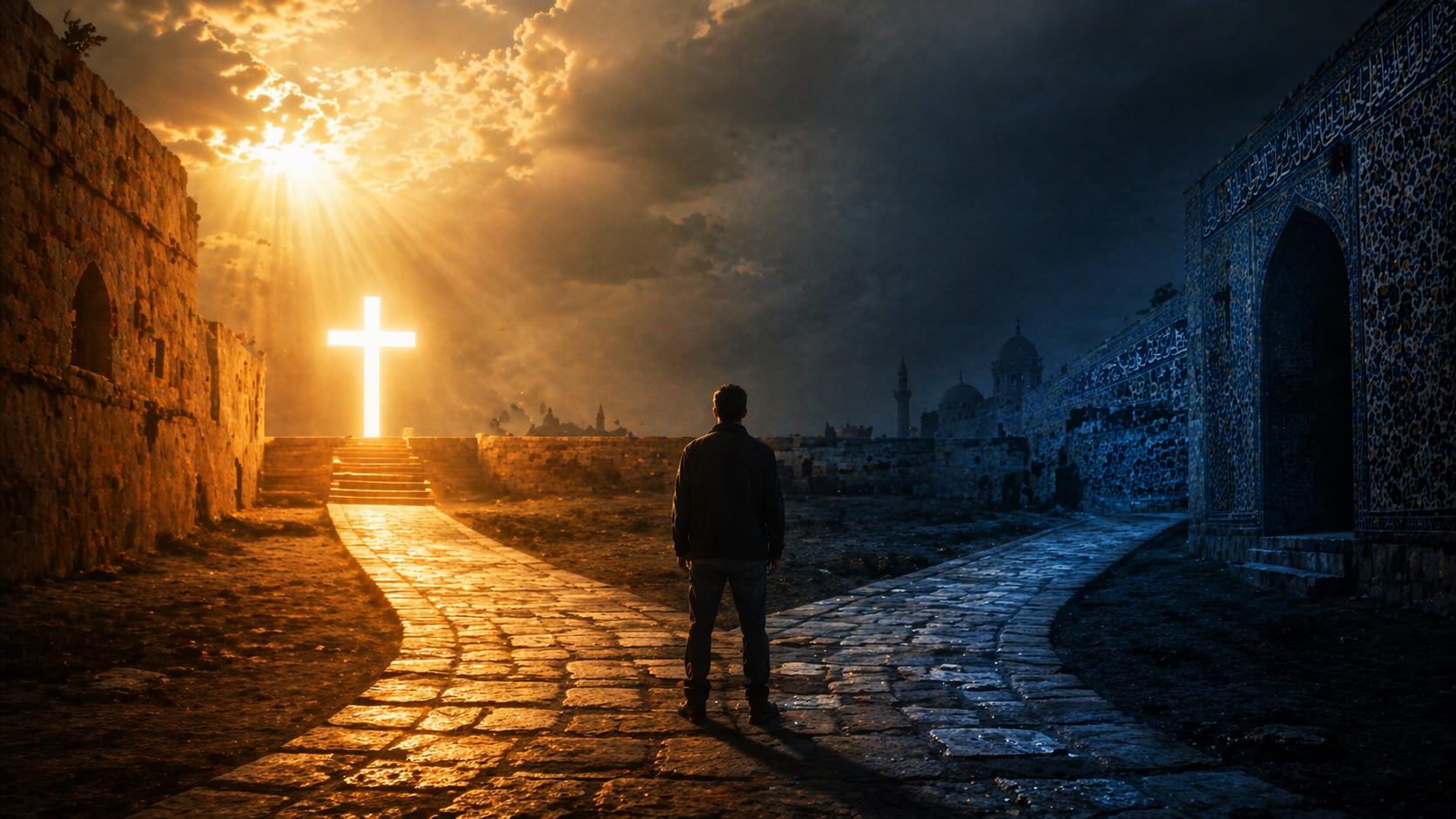

On April 13, 2026, Pope Leo XIV made history by becoming the first pontiff to visit Algeria. But it was what happened inside the Grand Mosque of Algiers that sparked controversy across the Christian world. The pope removed his shoes, stood beside the imam, and prayed silently for over 30 seconds — facing the qibla, the wall pointing toward Mecca.
This marked a dramatic shift. Just five months earlier in Istanbul, Pope Leo had declined an imam’s invitation to pray inside the Blue Mosque, choosing instead to simply “look around.” What changed between November and April? And more importantly: should Christians be concerned?
What Exactly Happened
The Grand Mosque of Algiers is the third-largest mosque in the world, with capacity for 120,000 worshippers and a minaret that soars 267 metres — the tallest on earth. Pope Leo toured the mosque for approximately ten minutes before pausing in what Vatican News described as “silent reflection” alongside the mosque’s rector, Mohamed Mamoun Al Qasimi.
The pope then called the mosque “a divine and sacred space” and “the space that belongs to God.” In a later statement, he urged Christians to be “perhaps a little less fearful of Islam.”
These words landed differently depending on who was listening. For some, they represented courageous interfaith bridge-building. For others, they sounded like theological surrender. At Higher Praise, we believe Christians deserve a thoughtful, Scripture-based response rather than knee-jerk reactions in either direction.
The Istanbul Precedent
Context matters. In November 2025, Pope Leo visited Istanbul’s iconic Blue Mosque — the same mosque where his predecessors Francis and Benedict XVI had both publicly prayed. But Leo declined the imam’s invitation to worship. The Vatican clarified that he experienced the visit “in silence, in a spirit of contemplation and listening, with deep respect for the place and the faith of those who gather there in prayer.”
That measured approach drew praise from Christian theologian Andy Bannister, who wrote that Pope Leo had modelled “how Christians can show respect for our Muslim friends, while being clear about our theological differences.” By showing politeness while declining to pray, Bannister argued, the pope sent a powerful message: difference need not divide us, but we do not believe the same thing.
So why pray in Algeria when he declined in Istanbul? The Vatican has offered no explanation for the shift. But the change was noticed — and it matters.
The Biblical Framework
Scripture does not explicitly forbid entering a building used by another religion. The apostle Paul walked through Athens observing altars to various gods before using one — dedicated “To an Unknown God” — as a launching point for the gospel (Acts 17:22-23). Jesus entered the Jerusalem Temple, which had been corrupted by money changers, and cleansed it rather than avoiding it (Matthew 21:12-13).
However, the Bible draws sharp lines around worship. The first two commandments are unambiguous: “You shall have no other gods before me” and “You shall not make for yourself an idol” (Exodus 20:3-4). These commands concern not just what we worship, but how and where we direct our worship.
Paul warned the Corinthians about participating in idol feasts: “You cannot drink the cup of the Lord and the cup of demons too; you cannot have a part in both the Lord’s table and the table of demons” (1 Corinthians 10:21). While Islam is not idol worship in the classical sense, the principle stands: Christians must guard against actions that blur the distinction between true worship and false worship.
The Problem with Praying Toward Mecca
Muslims pray toward Mecca because they believe the Kaaba — the black cube-shaped structure there — is the holiest site in Islam, built by Abraham and Ishmael. Five times daily, over a billion Muslims orient themselves in that direction.
When the Pope stood facing the qibla alongside the imam, the visual message was unmistakable: we worship together. Whether or not that was his intention, that is how it appeared — and in an image-driven world, appearance matters.
Compare this to Daniel’s practice in Babylon. Even under threat of death, Daniel “went home to his upstairs room where the windows opened toward Jerusalem. Three times a day he got down on his knees and prayed, giving thanks to his God” (Daniel 6:10). Daniel’s prayer posture was a statement: I worship the God of Israel, not the gods of Babylon.
Prayer direction is not trivial. It is a declaration of allegiance.
The Algeria Context
The location amplifies the concern. Algeria is 99% Muslim with fewer than 10,000 Catholics among 48 million people. Human rights organisations report that courts have imprisoned Christians and Ahmadi Muslims for “unauthorised worship” and “offence to Islam.” This is the context in which Pope Leo praised Algeria’s mosque as sacred space and urged less fear of Islam.
Algeria’s history complicates the picture further. During the “Black Decade” (1991-2002), nearly 200,000 Algerians died in violence between the government and Islamist groups. Nineteen Catholic priests and religious sisters were murdered during this period, beatified by the Vatican as martyrs. They died serving both Christians and Muslims with charity — and they died at the hands of Islamist extremists.
Behind the statue of the Black Virgin Mary in the Basilica of Our Lady of Africa are inscribed the words: “Pray for us and for the Muslims.” This remarkable inscription reflects a posture of love — but love for people is not the same as affirmation of a religion. Higher Praise believes we can pray for Muslims while maintaining that Islam is not a path to salvation.
Should Christians Enter Mosques?
Let us separate several questions that are often conflated.
First, can Christians enter a mosque? Entering a building is not inherently sinful. Christians visit mosques for cultural education, to understand their neighbours, and to build genuine friendships. Paul engaged with the religious spaces of his day as a platform for gospel proclamation.
Second, should Christians pray in mosques? This is more complicated. A Christian can pray anywhere — we carry the presence of God within us (1 Corinthians 6:19). However, participating in Islamic prayer rituals, praying toward Mecca, or joining in worship that denies Christ’s deity crosses a line. Such actions communicate something we do not believe.
Third, should Christian leaders publicly pray in mosques? This is where the stakes rise. Leaders represent not just themselves but the communities they serve. When the Pope prays in a mosque, the world watches. The message — intended or not — shapes how millions perceive Christianity’s relationship to Islam.
What Pope Leo Got Right
Before offering criticism, we should acknowledge what the pope got right.
He visited the Basilica of Saint Augustine in Annaba, honouring the great North African church father who shaped Christian theology for centuries. He celebrated Mass with Algeria’s tiny Catholic community and reminded them to “bear witness to the Gospel through simple gestures, genuine relationships and a dialogue lived out day by day.”
He honoured the 19 Catholic martyrs killed during Algeria’s civil war, noting they “remained faithful to charity even to the point of sacrificing themselves alongside many other men and women, Christians and Muslims.”
And he told Algeria’s authoritarian government that “authorities are called not to dominate, but to serve the people.” That took courage.
What Deserves Scrutiny
However, calling a mosque “a divine and sacred space” and “the space that belongs to God” raises theological questions. Is a building where Jesus Christ is denied as Lord and Saviour truly “sacred” in the Christian sense? Does God dwell in a place where the Trinity is rejected and the gospel contradicted?
Scripture reserves strong language for places of worship. Solomon’s Temple was sacred because God’s presence dwelt there. But God also abandoned that Temple when Israel turned to idolatry (Ezekiel 10:18-19). Holiness is not conferred by architecture; it flows from God’s presence and the truth of what is proclaimed.
Urging Christians to be “less fearful of Islam” is similarly complicated. Fear of Muslims as people is wrong — Jesus commands us to love our neighbours (Matthew 22:39). But vigilance about Islamic theology is not fear; it is faithfulness. When Islam teaches that Jesus was merely a prophet, that He did not die on the cross, and that salvation comes through submission to Allah rather than faith in Christ, Christians must disagree — lovingly but clearly.
A Higher Praise Perspective
At Higher Praise, we believe Christians can engage respectfully with Muslims without compromising the gospel. We can enter into genuine friendships, work together for the common good, and show Christ’s love in practical ways. We can visit mosques to learn and understand — but we must not participate in worship that contradicts the faith once delivered to the saints (Jude 1:3).
Pope Leo’s predecessor in theological controversy, Pope Benedict XVI, modelled this balance in 2006 at the same Blue Mosque in Istanbul. He observed a moment of “silent meditation” — but the Vatican was careful to describe it as meditation, not prayer. That distinction matters.
When Pope Leo not only prayed but faced Mecca alongside the imam, he crossed a line his previous Istanbul visit had carefully maintained. Whether this represents a deliberate theological shift or simply poor optics, the result is confusion among the faithful.
Conclusion
Should Christians be concerned about Pope Leo praying in the Grand Mosque of Algiers? We believe the answer is a cautious yes — not because visiting a mosque is sinful, but because the manner and messaging of this visit blurred important theological distinctions.
Christians can love Muslims, befriend Muslims, and even enter mosques — but we must never suggest that Christianity and Islam are simply different paths to the same God. They are not. Jesus Christ is “the way and the truth and the life” (John 14:6). No amount of interfaith diplomacy can change that reality.
The Higher Praise community stands for truth spoken in love. We pray for Pope Leo, for the Catholic faithful navigating this moment, and for Muslims around the world who are seeking the God who can be known — the God who revealed Himself not through a distant angel, but through a Person named Jesus.
FAQ — People Also Ask
Can Christians enter a mosque? Yes, Christians can enter mosques for cultural understanding, educational purposes, or to build relationships with Muslim neighbours. The Bible does not forbid entering buildings used by other religions. However, Christians should avoid participating in Islamic worship rituals that deny Christ’s deity or suggest Christianity and Islam lead to the same God.
Should Christians pray in a mosque? Christians can pray anywhere because God’s presence dwells within believers (1 Corinthians 6:19). However, participating in Islamic prayer rituals, praying toward Mecca, or joining worship that contradicts Christian doctrine crosses an important line. Prayer direction and posture communicate theological allegiance.
Did Pope Leo pray in a mosque? Yes. On April 13, 2026, Pope Leo XIV prayed silently for over 30 seconds inside the Grand Mosque of Algiers, standing beside the imam and facing the qibla (the direction of Mecca). This marked a change from his Istanbul visit in November 2025, when he declined an invitation to pray inside the Blue Mosque.
Why did Pope Leo visit Algeria? Algeria holds deep personal significance for Pope Leo as the birthplace of Saint Augustine, the theologian whose teachings shaped Leo’s religious order and spirituality. The pope visited Annaba (ancient Hippo), where Augustine served as bishop. He also sought to strengthen Christian-Muslim dialogue in the predominantly Muslim nation.
Is it a sin to visit a mosque? Visiting a mosque is not inherently sinful. The apostle Paul engaged with pagan religious spaces in Athens (Acts 17). However, Christians should maintain clear boundaries regarding worship. Observing and learning differs from participating in rituals that contradict the Christian faith.
Has a pope prayed in a mosque before? Yes. Pope John Paul II prayed at a mosque in Damascus in 2001. Pope Benedict XVI observed “silent meditation” at Istanbul’s Blue Mosque in 2006. Pope Francis prayed for two minutes at the same mosque in 2014. Each instance sparked debate about the boundaries of interfaith engagement.
Does Algeria persecute Christians? Human rights groups report that Algeria has imprisoned Christians and Ahmadi Muslims for “unauthorised worship” or “offence to Islam.” While the government presents itself as tolerant, religious minorities face significant restrictions. Catholics number fewer than 10,000 in a population of 48 million.