
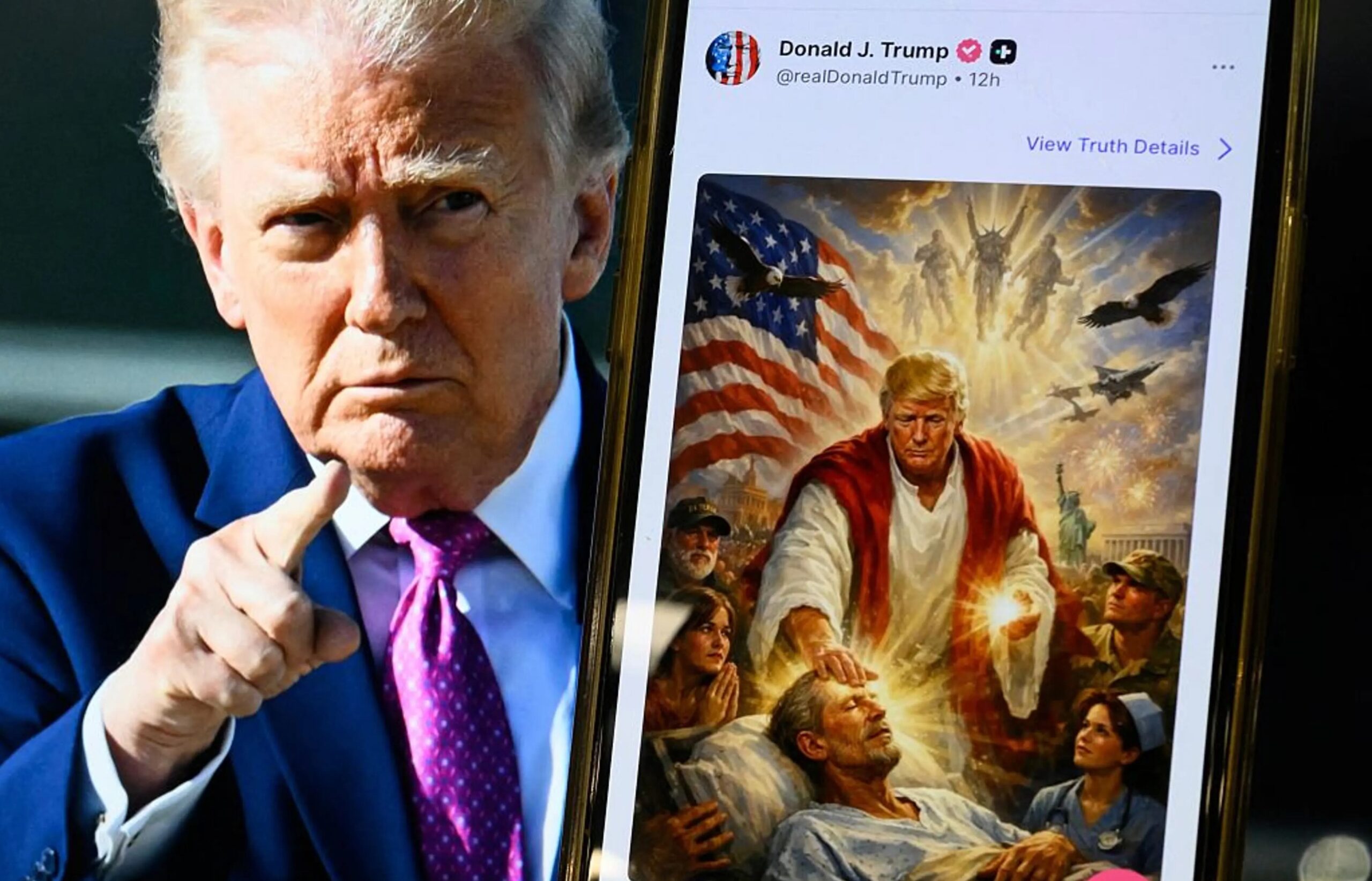

On Orthodox Easter Sunday, April 12, 2026, President Donald Trump posted an AI-generated image to his Truth Social platform that depicted him as a Christ-like figure. The image showed Trump wearing a white robe with light emanating from his hands, appearing to heal a kneeling figure in a scene unmistakably modelled on depictions of Jesus.
The reaction was swift and fierce — not from Trump’s critics, but from his most loyal Christian supporters.
“I don’t know if the President thought he was being funny or if he is under the influence of some substance or what possible explanation he could have for this OUTRAGEOUS blasphemy,” wrote Megan Basham, a prominent conservative Protestant commentator. “But he needs to take this down immediately and ask for forgiveness from the American people and then from God.”
Former congresswoman Marjorie Taylor Greene, once among Trump’s most vocal allies, was equally direct: “On Orthodox Easter, President Trump attacked the Pope because the Pope is rightly against Trump’s war in Iran and then he posted this picture of himself as if he is replacing Jesus. I completely denounce this and I’m praying against it.”
Trump deleted the image the following day. But the damage was done. At Higher Praise, we believe this moment deserves thoughtful biblical reflection — not partisan reaction.
What Happened
The image appeared amid Trump’s escalating public feud with Pope Leo XIV. The pope had criticised Trump’s threats against Iran, calling the president’s warning to “wipe out” Iranian civilisation “truly unacceptable.” Trump responded by calling the pope “weak on crime” and “terrible for foreign policy.”
The Christ-like image was posted the same evening. When questioned by reporters, Trump claimed the image depicted him “as a doctor” or “a Red Cross worker.” Vice President JD Vance dismissed it as “a joke,” adding that Trump “took it down because he recognised a lot of people weren’t understanding his humor.”
This was not an isolated incident. After Pope Francis died in 2025, Trump posted an AI-generated image of himself wearing papal robes. He has repeatedly described himself as “the chosen one” and claimed God “spared him” from assassination attempts.
The pattern raises a serious question: What does the Bible say about leaders who claim — or appear to claim — divine status?
The Second Commandment
God’s prohibition against images begins at Sinai. The second commandment states: “You shall not make for yourself an image in the form of anything in heaven above or on the earth beneath or in the waters below. You shall not bow down to them or worship them” (Exodus 20:4-5).
This command addressed two dangers: the creation of physical idols and the worship of those idols. Both represent humanity’s persistent temptation to control the divine — to shrink God down to a manageable size or shape Him according to our preferences.
When anyone depicts a human being — even a president — in the visual language reserved for Christ, they blur a line God drew clearly. The image itself becomes a statement: this person is like God. This person deserves the reverence we give to Jesus.
Whether Trump intended this message is known only to him and God. But the visual language was unmistakable to millions who saw it.
Blasphemy Defined
Blasphemy, biblically understood, involves speech or action that insults God, dishonours His name, or claims for oneself what belongs to God alone. The Greek root blasphēm- appears fifty-five times in the New Testament, carrying the sense of slander, reviling, or defaming the divine.
When the Pharisees accused Jesus of blasphemy, they did so because He claimed to forgive sins — a prerogative belonging only to God (Mark 2:7). Jesus’s claim was true; theirs was the blasphemy in denying it.
Is an AI image of a political leader depicted as Christ blasphemous? Christians disagree. Some argue it was merely tasteless humour. Others contend that depicting any human in messianic imagery — regardless of intent — trivialises the sacred and crosses a theological line.
What is clear is that Scripture takes seriously any confusion between Creator and creature. Paul warned that humanity’s fundamental error was exchanging “the glory of the immortal God for images made to look like mortal human beings” (Romans 1:23). The direction of that exchange matters: we are made in God’s image, not the reverse.
The Danger of Political Idolatry
The Trump image reveals a broader problem in American Christianity: the temptation toward political idolatry.
Idolatry, as theologians have long noted, rarely looks like bowing before golden statues. More often it involves giving ultimate allegiance to something other than God — trusting a political party, movement, or leader to deliver what only God can provide. It means looking to politics for meaning, identity, and salvation.
The prophet Samuel warned Israel about the dangers of earthly kings: “When you saw that Nahash king of the Ammonites was moving against you, you said to me, ‘No, we want a king to rule over us’ — even though the Lord your God was your king” (1 Samuel 12:12). Israel wanted a human deliverer they could see, touch, and control. God gave them what they asked for — and the consequences filled the rest of the Old Testament.
American Christians face the same temptation. When we invest a political leader with messianic hopes — expecting them to save the nation, restore righteousness, or defeat evil — we commit idolatry. When we excuse behaviour in “our” leader that we would condemn in another, we have placed party above principle and politics above Christ.
This is not a critique of conservatism or any policy position. It is a warning about the human heart. Political idolatry afflicts the left and right equally; it merely wears different clothing.
When Leaders Accept Worship
Scripture records what happens when human leaders accept divine honours.
In Acts 12, King Herod Agrippa delivered a public address. The crowd shouted, “This is the voice of a god, not of a man.” Herod did not correct them. “Immediately, because Herod did not give praise to God, an angel of the Lord struck him down, and he was eaten by worms and died” (Acts 12:22-23).
The lesson is stark: God does not share His glory. When leaders accept — or cultivate — worship that belongs to God alone, they invite divine judgment.
Nebuchadnezzar learned this lesson through humiliation. After boasting, “Is not this the great Babylon I have built as the royal residence, by my mighty power and for the glory of my majesty?” he was driven from human society to live like an animal until he acknowledged “that the Most High is sovereign over all kingdoms on earth” (Daniel 4:30-32).
We are not suggesting Trump will be struck down or driven mad. We are observing that Scripture treats human pride with deadly seriousness — especially the pride of rulers who forget they govern under God’s authority, not their own.
A Christian Response
How should believers respond to this incident?
First, we must guard our own hearts. The temptation to excuse what we want to excuse — because we agree with someone’s policies or fear their opponents — is the seedbed of idolatry. If we would be outraged by a Democratic president posting a Christ-like image, consistency requires equal concern when a Republican does so. Selective moral outrage reveals disordered loves.
Second, we should pray for our leaders. Paul instructs Timothy: “I urge, then, first of all, that petitions, prayers, intercession and thanksgiving be made for all people — for kings and all those in authority” (1 Timothy 2:1-2). This includes President Trump. We pray for his wisdom, his humility, and his genuine encounter with the Jesus he depicted in AI form.
Third, we must speak truth without hatred. Conservative writer Isabel Brown, who called the image “disgusting and unacceptable,” added that “nothing matters more than Jesus.” She continued supporting policies she agreed with while refusing to excuse behaviour that dishonoured Christ. That is the model: truth spoken clearly, without partisan rancour, with loyalty to Jesus above all.
Fourth, we should remember that no political leader — left, right, or centre — is the Messiah. America does not need a political saviour; America needs Jesus. When we forget this, we set ourselves up for disappointment, disillusionment, and the kind of moral compromise that damages our witness.
The Real Jesus
The real Jesus does not need AI enhancement. He does not need political endorsement. He is not strengthened by association with earthly power or diminished by its opposition.
The real Jesus was born in a stable, not a palace. He washed feet rather than demanding they be kissed. He entered Jerusalem on a donkey, not a warhorse. He conquered not by military might but by dying on a cross and rising from the grave.
The real Jesus said, “My kingdom is not of this world” (John 18:36). He told Pilate — the representative of the greatest political power on earth — “You would have no power over me if it were not given to you from above” (John 19:11).
This is the Jesus the Higher Praise community worships: not a projection of American power, not a mascot for any political party, but the crucified and risen Lord before whom every knee will bow and every tongue confess — including presidents, popes, and everyone who has ever lived.
Conclusion
President Trump’s AI image sparked justified concern among Christians who rightly guard against any confusion between human leaders and the divine Christ. That the image was deleted suggests at least some recognition that it crossed a line.
But the deeper lesson extends beyond one post on one platform. Political idolatry is a persistent danger for American Christians. We are tempted to invest ultimate hopes in penultimate things, to treat elections as apocalyptic battles between good and evil, to excuse in our allies what we condemn in our opponents.
The antidote is not political disengagement but proper ordering. We can participate in politics, advocate for policies, and support candidates — all while remembering that our citizenship is ultimately in heaven (Philippians 3:20). We can honour governing authorities (Romans 13:1) while refusing to worship them.
Jesus Christ is Lord. No president, no king, no emperor shares that title. When we remember this — truly remember it — we are free to engage politics without being enslaved by it, to support leaders without idolising them, and to speak truth to power because we answer to a higher Power still.
May we hold fast to Christ alone. He is enough.
FAQ — People Also Ask
What did Trump post about Jesus? On April 12, 2026 (Orthodox Easter Sunday), President Trump posted an AI-generated image on Truth Social depicting himself in a white robe with light emanating from his hands, appearing to heal a kneeling figure in a scene resembling depictions of Jesus Christ. He deleted the image the following day after backlash from Christian supporters who called it blasphemous.
Is it blasphemy to depict yourself as Jesus? Blasphemy involves speech or action that insults God or claims for oneself what belongs to God alone. Many Christians consider depicting a human being in messianic imagery to be blasphemous because it blurs the distinction between Creator and creature. Others view such images as merely tasteless. Scripture warns against exchanging “the glory of the immortal God for images made to look like mortal human beings” (Romans 1:23).
What does the Bible say about political idolatry? The Bible warns repeatedly against placing ultimate trust in human leaders rather than God. The first two commandments prohibit idolatry and the making of images for worship (Exodus 20:3-5). Scripture shows the consequences when leaders accept divine honours (Acts 12:21-23) or when nations demand human kings instead of trusting God (1 Samuel 12:12). Christians are called to honour governing authorities (Romans 13:1) without worshipping them.
What happened to Herod when he accepted worship? In Acts 12:21-23, King Herod Agrippa gave a public address and the crowd shouted, “This is the voice of a god, not of a man.” Because Herod did not reject this praise and give glory to God, “an angel of the Lord struck him down, and he was eaten by worms and died.” Scripture treats the acceptance of divine worship by human leaders as a serious offence against God.
How did Christians react to Trump’s Jesus image? Many prominent conservative Christians condemned the image. Megan Basham called it “OUTRAGEOUS blasphemy.” Marjorie Taylor Greene said she “completely denounced” it. Isabel Brown of the Daily Wire called it “disgusting and unacceptable.” Conservative activist Riley Gaines said “a little humility” would serve Trump well. Vice President JD Vance dismissed it as “a joke” that people misunderstood.
What is the second commandment? The second commandment states: “You shall not make for yourself an image in the form of anything in heaven above or on the earth beneath or in the waters below. You shall not bow down to them or worship them” (Exodus 20:4-5). This prohibition addresses both the creation of physical idols and the worship of such images, warning against humanity’s temptation to represent or control the divine.