Advent Candles Meaning: Each Candle, the Colors and the Wreath
What the Advent candles mean: hope, peace, joy, love and the Christ candle, the colors, the wreath, its 1839 origin, 2026 dates and a reading and prayer for each week.
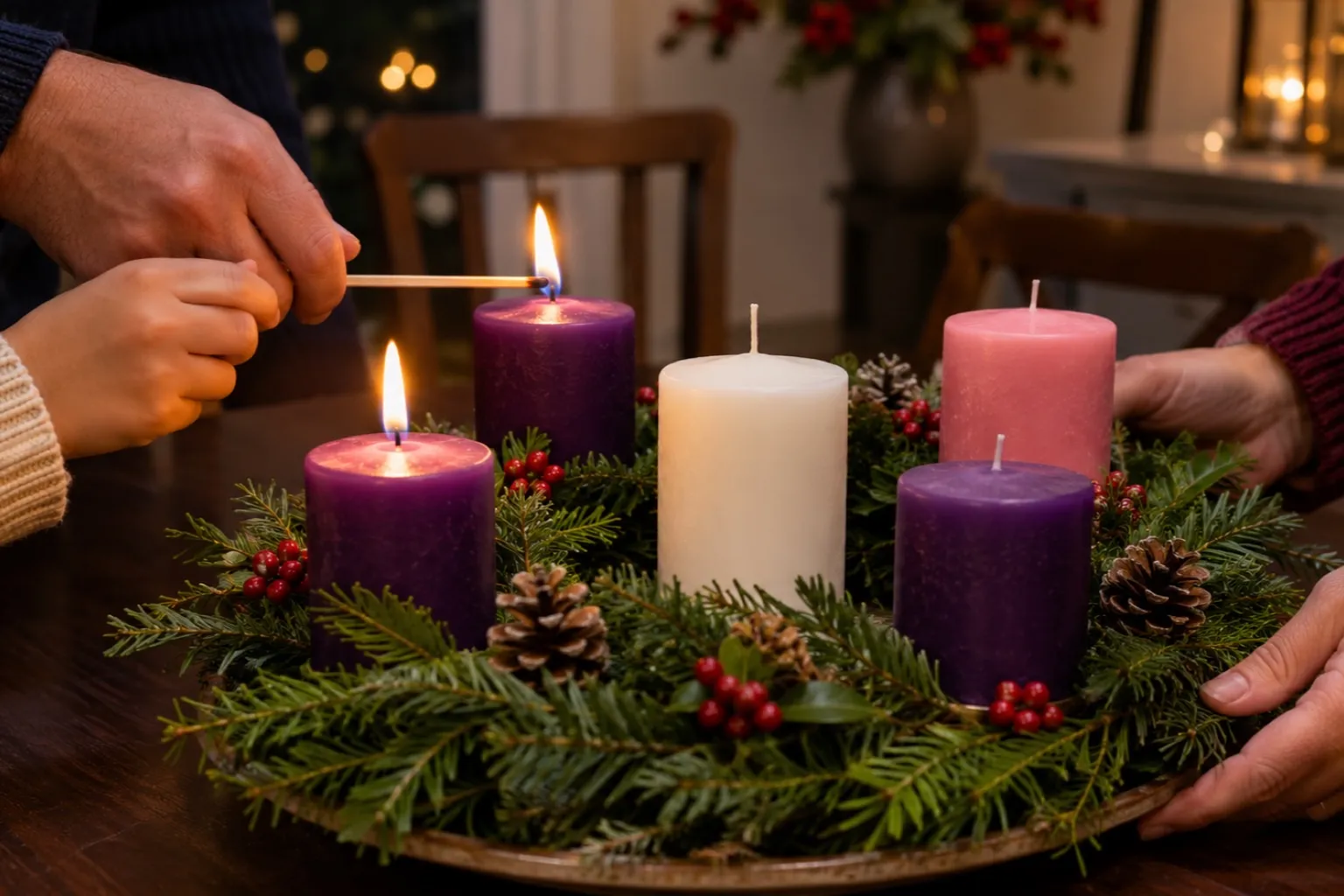
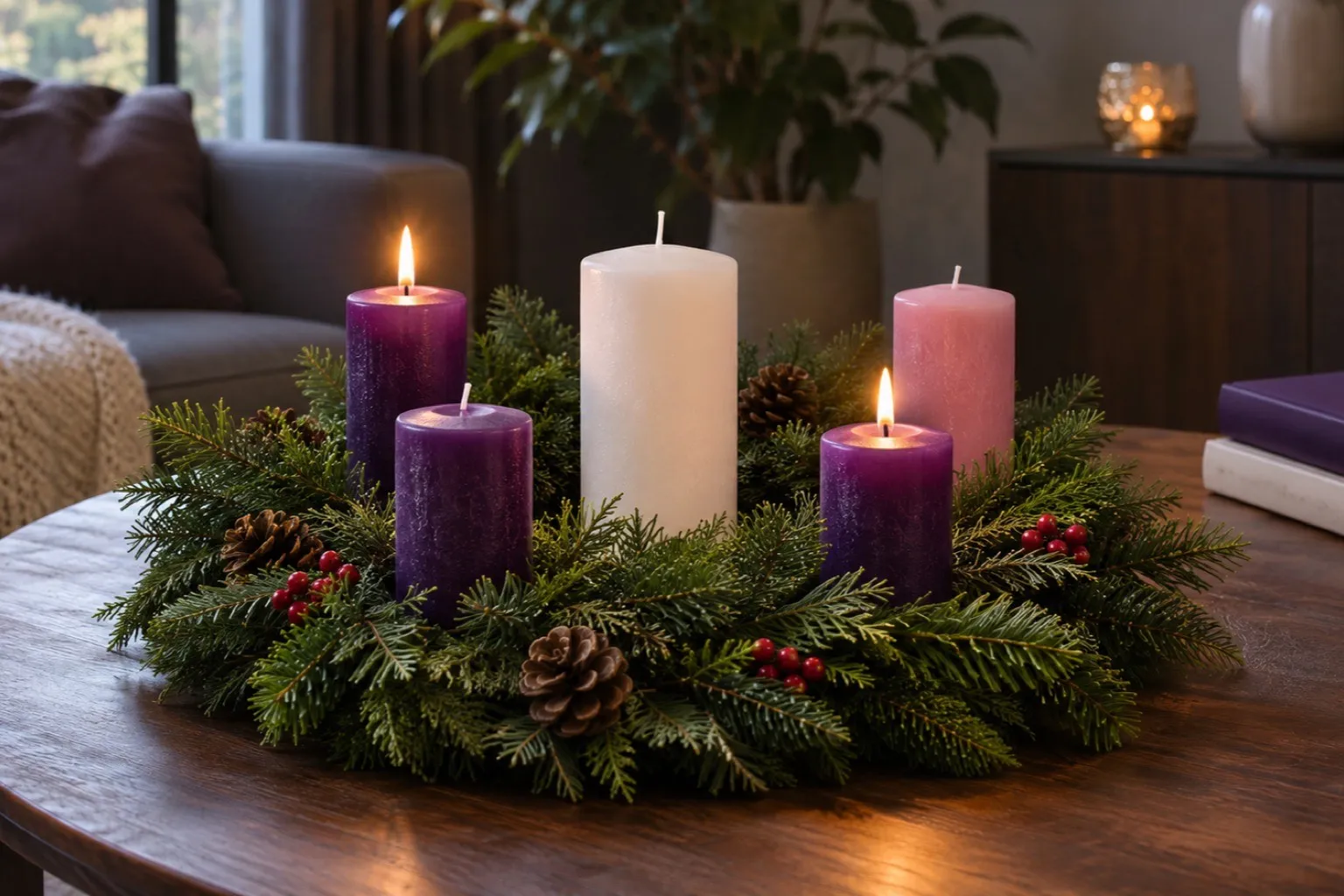
The four Advent candles stand for hope, peace, joy and love, one for each Sunday of Advent, and a fifth white candle in the center, the Christ candle, celebrates the birth of Jesus on Christmas Eve or Christmas Day. Their older names are the prophecy, Bethlehem, shepherds' and angels' candles. Traditionally three are purple or blue and the third-Sunday candle is rose, for joy.
In 2026 the first candle is lit on Sunday, November 29. Below is each candle's meaning, the colors, the symbolism of the wreath, where the custom came from, and a short reading and prayer for each week that a family or church can use as it stands.
Advent candles meaning at a glance
- First Sunday (November 29, 2026): Hope. The prophecy candle. Purple or blue.
- Second Sunday (December 6, 2026): Peace. The Bethlehem candle. Purple or blue.
- Third Sunday (December 13, 2026): Joy. The shepherds' candle. Rose or pink.
- Fourth Sunday (December 20, 2026): Love. The angels' candle. Purple or blue.
- Christmas Eve or Christmas Day (December 24 or 25, 2026): Christ. The Christ candle. White, in the center.
Each week you light the new candle and relight the ones from earlier weeks, so the light grows as Christmas comes closer. That growing light is the heart of the custom: the world was waiting in the dark, and the light of the world was on his way.
Traditions differ, and that is worth saying up front. Some churches use the order hope, love, joy, peace. Some name the candles after people in the story, such as the prophets, Mary, John the Baptist and the angels. Many use four white or red candles with no color code at all. None of these is wrong. The candles are a teaching aid, not a command.
What does the Advent wreath mean?
The candles usually sit in a wreath, and the wreath has its own meaning:
- The circle has no beginning and no end. It points to the eternal God and to the everlasting life he gives.
- The evergreen branches stay green through the winter, a picture of life that does not fade and of hope that lasts when everything else looks dead.
- The light grows week by week, showing Christ coming into a dark world.
Over time, families and writers have added further meanings to the materials. Some see the prickly leaves of holly as a reminder of the crown of thorns, and pinecones or seeds as signs of new life and resurrection. These are devotional ideas rather than fixed rules, but they can be good prompts for a conversation with children.
For the bigger picture of the season itself, its meaning, its dates and how different churches keep it, see our guide What Is Advent?
The first Advent candle: hope (the prophecy candle)
The first candle recalls the prophets who promised that God would send a rescuer. For centuries Israel waited, through exile and silence, holding on to those promises. Isaiah saw light breaking into deep darkness.
Isaiah 9:2 — "The people who walked in darkness have seen a great light. Those who lived in the land of the shadow of death, on them the light has shined."
Christian hope is not wishful thinking. It is confidence that God keeps his word, because he has kept it before. The first candle is lit on the first Sunday of Advent, which in 2026 is November 29.
A simple reading: Isaiah 9:2-7.
A prayer for the first week:
Father, you kept your promises to your people through long years of waiting. Give us hope that rests on your word, not on our circumstances. As we light this candle, help us trust you with what we are still waiting for. In Jesus' name, Amen.
The second Advent candle: peace (the Bethlehem candle)
The second candle points to Bethlehem, the small town where the Messiah would be born. Micah named it about seven hundred years before Jesus arrived there.
Micah 5:2 — "But you, Bethlehem Ephrathah, being small among the clans of Judah, out of you one will come out to me that is to be ruler in Israel; whose goings out are from of old, from ancient times."
Micah goes on to say that this ruler would himself be his people's peace (Micah 5:5). The peace of Advent is more than calm. It is the restored relationship with God that Jesus came to bring, and the peace between people that grows from it. In 2026 the second candle is first lit on Sunday, December 6.
A simple reading: Micah 5:2-5.
A prayer for the second week:
Heavenly Father, you chose a small town to bring the King of peace into the world. Quiet our anxious hearts and make us peacemakers in our homes this week. Show us anyone we need to forgive. In Jesus' name, Amen.
The third Advent candle: joy (the shepherds' candle)
The third candle is the different one. In the traditional scheme it is rose or pink, and it is lit on the third Sunday of Advent, called Gaudete Sunday. Gaudete is Latin for "rejoice," the first word of the old Latin chant for that day, drawn from Philippians 4:4. Advent was once a more solemn season of fasting, and this Sunday marked a lighter, joyful pause halfway through. The same rose color is used on a matching Sunday in the middle of Lent.
The candle is named for the shepherds, ordinary working men who were the first to hear the news.
Luke 2:10-11 — "The angel said to them, “Don’t be afraid, for behold, I bring you good news of great joy which will be to all the people. For there is born to you, this day, in the city of David, a Savior, who is Christ the Lord.”"
In 2026 the joy candle is first lit on Sunday, December 13.
A simple reading: Luke 2:8-20.
A prayer for the third week:
Father, the angel brought good news of great joy to shepherds in a field at night. Fill us with that same joy, the kind that does not depend on how our week went. Help us share the good news with someone who needs it. In Jesus' name, Amen.
The fourth Advent candle: love (the angels' candle)
The fourth candle is named for the angels who announced the birth of Jesus and filled the night sky with praise.
Luke 2:13-14 — "Suddenly, there was with the angel a multitude of the heavenly army praising God, and saying, “Glory to God in the highest, on earth peace, good will toward men.”"
Its theme is love, because the whole story begins with God's love. He did not send a message or a messenger only. He sent his Son (John 3:16). In 2026 all four candles burn together for the first time on Sunday, December 20.
A simple reading: Luke 1:26-38, or 1 John 4:9-10.
A prayer for the fourth week:
Heavenly Father, you loved the world so much that you gave your only Son. Help us receive that love and pass it on, especially to those who feel forgotten this Christmas. In Jesus' name, Amen.
The Christ candle: the white candle in the center
The fifth candle stands in the middle of the wreath and is white, the color of purity and celebration. It represents Jesus himself, and it is lit on Christmas Eve or Christmas Day, after the waiting is over. In 2026 Christmas Eve falls on a Thursday and Christmas Day on a Friday. Many families light it at a Christmas Eve meal or after a late service, and keep lighting all five candles through the twelve days of Christmas.
Isaiah gave the promised child names that belong to God alone.
Isaiah 9:6 — "For to us a child is born. To us a son is given; and the government will be on his shoulders. His name will be called Wonderful, Counselor, Mighty God, Everlasting Father, Prince of Peace."
And Jesus later said plainly who the light was.
John 8:12 — "Again, therefore, Jesus spoke to them, saying, “I am the light of the world. He who follows me will not walk in the darkness, but will have the light of life.”"
A simple reading: Luke 2:1-7 and John 1:1-14.
A prayer for Christmas:
Father, the light we have waited for has come. Thank you for sending Jesus to be born among us, to live and die and rise again for us. Let his light shine in our home all year long. In Jesus' name, Amen.
To explore the titles in Isaiah 9:6 and many others, see our page on the names of Jesus.
Advent candle colors: why purple, blue and pink?
- Purple is the historic color of Advent in Catholic and many Protestant churches. It speaks of royalty, because the coming child is a king, and of repentance, because the season was once kept with fasting.
- Blue is used by many Lutheran, Methodist and some Anglican churches. It points to hope and expectation and keeps Advent distinct from Lent, which also uses purple.
- Rose or pink is for the third Sunday, Gaudete Sunday, the candle of joy.
- White is for the Christ candle, lit at Christmas.
- Red candles, often all four the same, are common in Britain.
Many evangelical and non-denominational families simply use whatever candles they have. The color is a helpful signal, but the meaning lives in the readings and prayers, not in the wax.
When do you light the Advent candles in 2026?
- Sunday, November 29: light the first candle (hope).
- Sunday, December 6: light the first and second candles (peace).
- Sunday, December 13: light the first three, including the rose candle (joy).
- Sunday, December 20: light all four (love).
- Thursday, December 24, or Friday, December 25: light all four and the white Christ candle.
Churches light the new candle during the Sunday service. At home, many families light it on Sunday and then relight that week's candles each evening at dinner, adding a short reading or a verse of a carol. If you miss a Sunday, just light the right number of candles the next time you gather.
Where did the Advent wreath come from?
The Advent wreath as we know it is usually traced to Johann Hinrich Wichern (1808-1881), a Lutheran pastor in Hamburg, Germany. In 1833 he founded the Rauhes Haus, a home for neglected and poor children. The children kept asking how long it was until Christmas.
In Advent 1839, Wichern hung a large wooden ring, often described as an old cartwheel, in the home's prayer hall and set a candle on it for every day from the first Sunday of Advent to Christmas Eve. One more candle was lit each day, so the children could see Christmas coming. Because Advent varies in length, the number of candles changed from year to year.
Later retellings describe small red candles for weekdays and large white candles for Sundays. Research in the Rauhes Haus archives has questioned whether the original candles really differed in size or color, so that detail is less certain than the story is usually told.
Around 1860, fir branches were added to the ring. The custom spread through Protestant Germany, was taken up by Catholic churches in Germany in the 1920s, and reached North America in the 1930s. In homes, the big ring of daily candles shrank to the four Sunday candles most people use today, which fit more easily on a table.
Customs of greenery and light in the dark months are older than Wichern, and some writers trace earlier forms among German Lutherans. But the wreath most churches use today grew from a pastor trying to help children wait well for Christmas.
How to light the Advent candles at home
A family Advent wreath takes about ten minutes. Here is a simple order you can follow each Sunday:
- Gather. Turn down the lights and sit together around the wreath.
- Relight. Light the candles from earlier weeks.
- Read. Read the week's passage aloud. Children can take turns.
- Light the new candle. Say the week's theme together: "Tonight we light the candle of hope."
- Talk. Ask one question, such as "What are we hoping God will do?"
- Pray. Use the prayer above or your own words.
- Sing. End with a verse of an Advent hymn or a carol.
A practical note: never leave lit candles unattended, keep the wreath away from curtains and dry branches, and consider battery candles if very young children are lighting them. For more readings to use through December, see our list of Christmas Bible verses.
How churches light the Advent candles
In many churches a family, a couple or a reader comes forward each Sunday to light the candle near the start of the service. Typically they read a short passage, light the new candle, say a brief prayer, and the congregation sings a verse of an Advent hymn. Some churches use a responsive reading in which the leader and congregation take turns.
Asking different households to lead each week is a simple way to involve people who do not usually speak in church, including children and new members. Pastors planning the season can find themes and passages in our Advent sermon and Christmas sermon outlines, and can map out the Sundays with the preaching calendar.
FAQ
What are the four Advent candles called?
In the most common modern scheme they are hope, peace, joy and love. Their older names are the prophecy candle, the Bethlehem candle, the shepherds' candle and the angels' candle. Some churches use other names or a different order.
Why is one Advent candle pink?
The pink or rose candle is lit on the third Sunday of Advent, called Gaudete Sunday from the Latin word for "rejoice." It marks a joyful pause in a season that was traditionally solemn. In the modern scheme it is the candle of joy.
Which Advent candle do you light first?
Light one of the purple or blue candles first, the candle of hope or prophecy. The rose candle waits for the third Sunday. Each week you relight the earlier candles and add one more.
What does the white candle in the middle mean?
The white center candle is the Christ candle. It represents Jesus and is lit on Christmas Eve or Christmas Day to celebrate that the one the season has waited for has come.
Do you light the Advent candles every day?
The new candle is lit on Sunday. Many families relight the week's candles every evening at a meal or family devotions, which keeps the season in view all week. Either way is fine.
Do you have to follow the church calendar to use an Advent wreath?
No. The Bible does not command an Advent wreath, and Christians are free to use one or not. Many churches that do not follow a full church calendar still find it a simple, memorable way to prepare for Christmas.