What Was the Star of Bethlehem? What the Bible Says and What It Might Have Been
The Star of Bethlehem led wise men from the east to the newborn Jesus. The Bible never says what it was — a conjunction, a comet, a new star or a miracle — only what it was for.
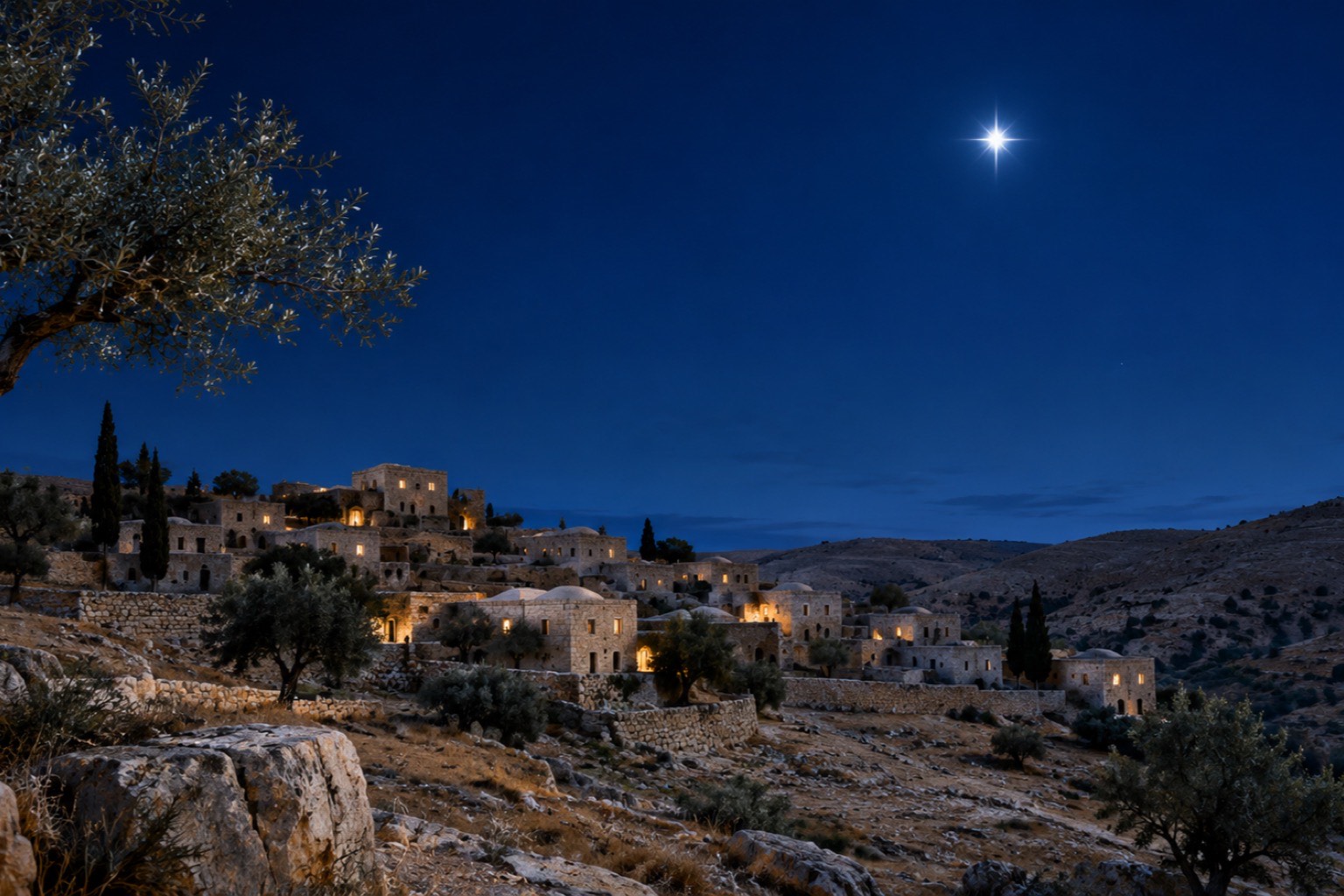
What was the Star of Bethlehem? Every December the question comes back, on Christmas cards and in planetarium shows, and it is a fair one. Matthew says a star led wise men to a child. He does not say what kind of star it was.
The Short Answer
The Star of Bethlehem is the star that, according to the Gospel of Matthew, brought wise men from the east to worship the newborn Jesus. The Bible never explains what it was. Christians have suggested a planetary conjunction, a comet, a new star, or a miracle with no natural cause — and nobody can prove which. What Matthew is sure of is what the star was for: it led people who were far away to Jesus.
What the Bible Actually Says About the Star
The star appears in one place only, Matthew 2. Luke tells of shepherds and angels and never mentions it. Matthew introduces it with the wise men already on the road.
Matthew 2:1-2 — "Now when Jesus was born in Bethlehem of Judea in the days of King Herod, behold, wise men from the east came to Jerusalem, saying, 'Where is he who is born King of the Jews? For we saw his star in the east, and have come to worship him.'"
Notice what is and is not there. The wise men saw the star "in the east," and they went to Jerusalem, the capital, where a king would be expected. It was the scribes, reading the prophet Micah, who sent them on to Bethlehem (Matthew 2:4-6). Only then does the star reappear.
Matthew 2:9-10 — "They, having heard the king, went their way; and behold, the star, which they saw in the east, went before them, until it came and stood over where the young child was. When they saw the star, they rejoiced with exceedingly great joy."
Matthew also says they found the child in a house, not a stable (Matthew 2:11). The nativity scene that puts shepherds and wise men side by side is a kindness to children, not a timeline.
Who Were the Wise Men?
Matthew calls them wise men from the east and tells us little more. He does not say there were three — that comes from the three gifts of gold, frankincense and myrrh — and he does not call them kings. They were most likely scholars who studied the sky, from somewhere east of Judea. They were outsiders to Israel, and Matthew wants us to see that. The first people in his Gospel to worship Jesus are foreigners.
What Could the Star of Bethlehem Have Been?
This is where Christians honestly disagree, and where astronomers have joined in for centuries. There are four main views.
View 1: A Meeting of Planets
When two bright planets pass close together in the sky, it is called a conjunction. The astronomer Johannes Kepler worked out that Jupiter and Saturn met in this way in 7 BC, and others have pointed to later meetings of Jupiter and Venus. To people who read meaning in the sky, a rare conjunction could have announced a royal birth. The weakness is that Matthew describes one star, and a conjunction does not stand over a house.
View 2: A Comet
A comet moves against the background stars and can seem to point with its tail, which fits a star that "went before them." The difficulty is that the ancient world usually read comets as bad omens, not as news of a king to be worshiped.
View 3: A New Star
A nova is a star that suddenly flares bright enough to be seen where nothing was visible before. That would explain why the wise men spoke of "his star" as something new. It would not explain how a star moved ahead of them or stopped.
View 4: A Miracle
Many Christians believe the star had no natural explanation at all — that God made a light for this purpose alone. This view takes the strangest details most seriously: a star that goes ahead of travelers on a short road south and then stands over one home behaves like a guide, not like anything in an astronomy textbook.
We do not think a Christian has to choose. God made the heavens and can use them, and he can also do what the heavens do not do by themselves.
Psalm 19:1 — "The heavens declare the glory of God. The expanse shows his handiwork."
Did the Old Testament Predict the Star?
Matthew quotes Micah about Bethlehem, but he quotes no prophecy about a star. Many readers have connected it with an older line spoken by Balaam.
Numbers 24:17 — "I see him, but not now. I see him, but not near. A star will come out of Jacob. A scepter will rise out of Israel, and shall strike through the corners of Moab, and break down all the sons of Sheth."
In that verse the star is a person, a ruler who will come from Israel. Matthew does not make the link himself, so we should hold it loosely. It is still striking that a prophecy pictures the coming king as a star, and a star then marks his birth.
Does the Star Mean the Bible Approves of Astrology?
No. Scripture warns Israel against looking to the sun, moon and stars for guidance or worship (Deuteronomy 4:19). The story of the wise men does not undo that. The star got them as far as Jerusalem; it took Scripture to get them to Bethlehem. And when they arrived, they did not worship the star. They worshiped the child.
What the story shows is God meeting people where they already were. These men watched the sky, so God spoke to them in the sky, and then led them to something better than the sky.
Why the Star of Bethlehem Matters
Here at Higher Praise, we think the most important thing about the star is the direction it pointed. Three things stand out.
- It was for outsiders. The star was seen by people far from Israel, with no Scripture of their own. From the first chapter of his life, Jesus is for the nations.
- It led to worship. The wise men did not come to study a phenomenon. They came to kneel, and they went home changed (Matthew 2:12).
- It was enough light for the next step. They were not given a map. They were given a star, then a Scripture, then the star again.
What If I'm Not Sure It Really Happened?
You are not the first to wonder, and wondering does not put you outside. Matthew wrote for readers who could still ask people who remembered those years, and he tells the story plainly, without decoration. If you find the star hard to believe, start where the wise men ended instead of where they began — with the child himself. People who cannot settle the star have still found that Jesus is worth the journey.
Conclusion
The Star of Bethlehem may have been planets meeting, a comet, a new star, or a light God made for one night's work. The Bible does not say, and we should be content not to know. What it does say is that God put a sign in the sky for people who were looking, and that those who followed it found Jesus and rejoiced.
What do you think the star was? Tell us in the comments — and tell us what first pointed you toward Jesus.